
Human rights experts discuss civilian protection during conflicts at Watson roundtable
Fuente del clip de prensa: Brown Daily Herald
Por: Miriam Davison
Speakers from three human rights organizations tackled issues from the conflict in Ukraine to reproductive injustice.
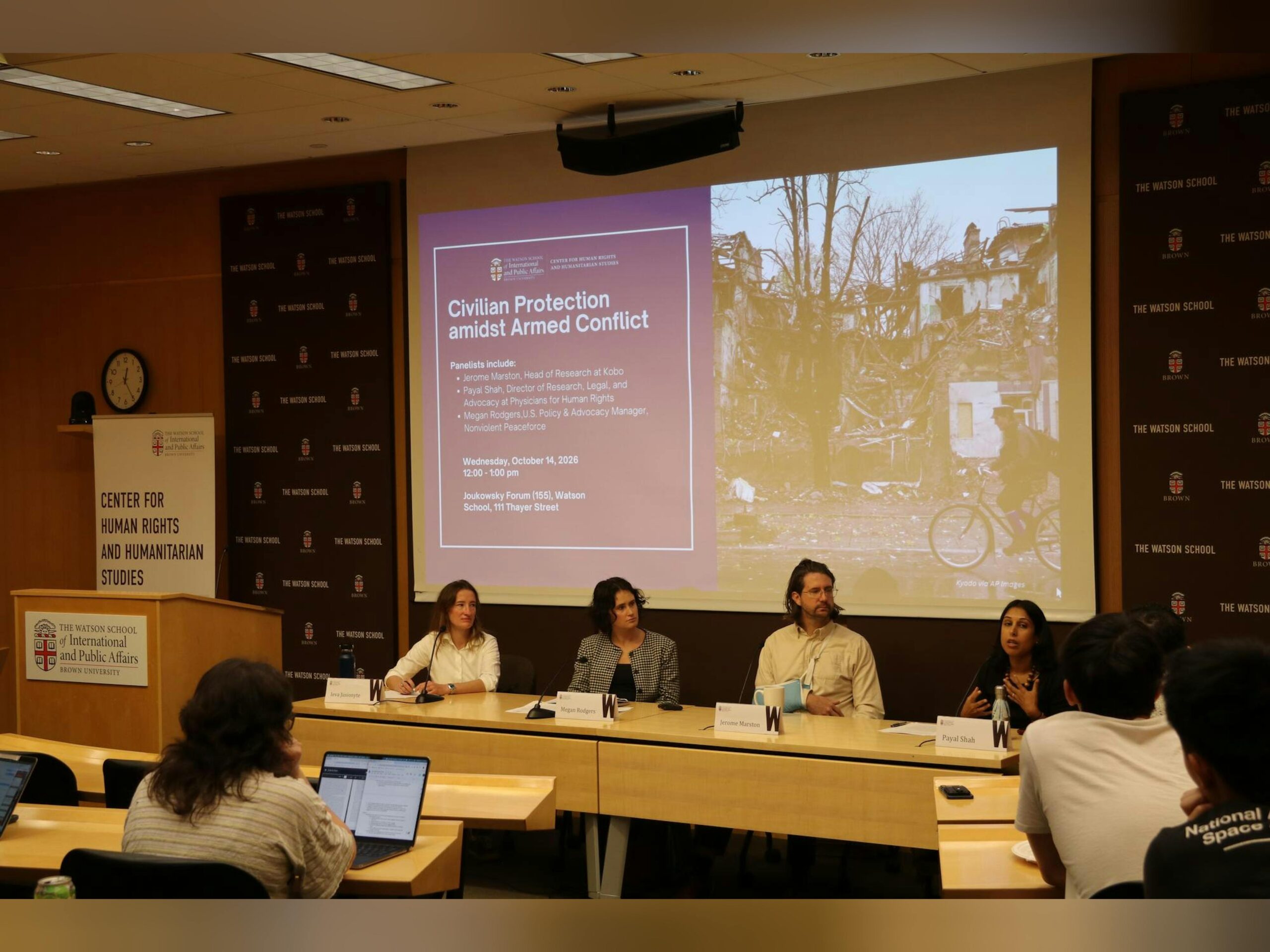
On Wednesday, researchers and advocates gathered at the Watson School of International and Public Affairs to discuss their work documenting harm to civilians in war zones, from attacks on civilian infrastructure to the limits of international law.
The roundtable, titled “Civilian Protection amidst Armed Conflict,” featured Jerome Marston PhD’19, head of research at Kobo, a nonprofit that collects data for humanitarian causes; Payal Shah, director of research, legal and advocacy at Physicians for Human Rights; and Megan Rodgers, United States policy and advocacy manager at Nonviolent Peaceforce.
Marston presented findings from a nationwide survey of Ukrainian households conducted by Kobo. Published this spring, the research examines how power outages affect civilians beyond the immediate loss of electricity.
“It’s not just lost lights or lost power,” he told The Herald. “It intersects with so many facets of civilian life,” including heating, medical care, food storage, education and income.
Ninety-seven percent of respondents reported experiencing electricity outages they attributed to the war, Marston said. In his talk, he said the survey also found significant impacts on education, with a large portion of civilians reporting that children in their households were unable to participate in remote education during outages.
With winter approaching, further attacks on energy infrastructure could have significant consequences for civilians, Marston said. Kobo recently shared its research and recommendations with the United Nations’ Independent International Commission of Inquiry on Ukraine, according to Marston. Its recommendations included providing high-capacity generators for medical facilities, backup power for households with medical needs and expanding community “invincibility centers,” which offer charging stations, first aid and heat.
Shah discussed Physicians for Human Rights’ work documenting global attacks on health care and investigating violations of international human rights and humanitarian law. The organization helps clinicians document violations and develops tools for collecting and securely sharing evidence with survivors’ consent, she told The Herald.
At the event, Shah talked about the organization’s work in Myanmar, where forensic medical evaluations of survivors and interviews with health care professionals indicated that “state security forces deliberately targeted women of reproductive age with violence against their genitals and reproductive organs, and also committed acts of forced pregnancy.”
Shah described her work as an effort to push back against human rights violations through interdisciplinary collaboration.
During the final talk of the afternoon, Rodgers focused on practical approaches to civilian protection around the world, noting that the use of drone attacks can create new risks for civilians and humanitarian workers.
Rodgers cited 77 drone-related incidents involving humanitarian vehicles in Ukraine so far this year, 48 of which “had some form of humanitarian marking present, which means that under international law, they should not be targeted by drone attacks.”
“I think we find ourselves in the international humanitarian community in an interesting bind, where the tools that we have used — international humanitarian law — are failing in the protection of civilians,” Rodgers said.
Nonviolent Peaceforce — which operates in 10 conflict zones with a staff of about 300 — works with communities to “improve the tools and the methodologies at their own disposal to keep themselves safe in the midst of conflict,” Rodgers said.
She also described a pressing dilemma that humanitarian organizations face: Some measures civilians use to defend themselves against drones, such as electronic jammers, which disrupt radio frequencies, could “be interpreted as participating in that conflict.”
“There is a delineation in international humanitarian law where civilians must not become active participants in armed conflict,” Rodgers said. If civilians do find themselves as active participants, then “they become, under international humanitarian law, legal targets.”
Jack Zarate ’27, an event attendee, said he found “the three (speakers) coming at this from different angles really enriched” his understanding of humanitarian work in conflict zones.
Mohammad Matin-Nejad GS, who is pursuing a Master of Public Health and Master of Public Affairs, said he attended the event to learn more about how civilians are affected by conflict. “It’s empowering in a way and really inspiring to know that there are ways to make a difference,” he said.
For Bohdán Andrashko ’30, a student from Ukraine, the event was a starting point. “It was useful to know that organizations like these exist,” he said. “For the future, I’ll look more into it and see maybe how I can be useful and get involved as well.”