
Op Ed: We keep asking if drones win wars. We should be asking who they’re killing.
Fuente del clip de prensa: Physical copy published in UNGA 81 Edition (September 2026) of Envoy Magazine; Digital copy forthcoming
Escrito por: Joachim (Yomi) Kleinmann
As militaries race to deploy cheaper and more lethal drones, Joachim Kleinmann argues that the humanitarian system is still failing to confront what they mean for civilians.
Every week, another update about drones makes news headlines: How they are reshaping the battlefield. How cheap they are. How a $500 commercial quadcopter can now take out a $2 million armored vehicle. The coverage is thorough, technically sophisticated, and almost entirely focused on one question: How effective are drones in wars?
Instead, the question we should be asking is: How devastating is drones’ impact on civilians?
In Ukraine, where I lead civilian protection programs for Nonviolent Peaceforce (NP), I have watched drone warfare transform not only the battlefield but the daily calculations of survival.
Since the beginning of the war, drone warfare has evolved in real time, becoming one of the defining risks in modern conflict. In Ukraine, civilian protection teams have had to adapt quickly, developing field-tested measures to keep civilians, humanitarians and local partners safe from an increasingly pervasive threat.
Our work is grounded in humanitarian principles—and in hard reality. In Ukraine, a team can plan an entire day of evacuations and abandon it entirely because a drone is circling the route. Canceling means leaving people in danger. Going ahead might be worse. That is the impossible calculation local responders face every single day.
What the coverage misses
The drones reshaping conflict today are fast, cheap, and ubiquitous. First-person view (FPV) attack drones—commercial quadcopters modified into lethal weapons—cost as little as a few hundred dollars and can be piloted by someone who learned on a gaming console.
For next year, 2027, the Pentagon has requested more than $74 billion in drone-related spending. That number tells you where this is going.
The lethal use of drones in warfare is not confined to any one war. In Gaza, surveillance and attack drones have been a constant presence for years, only evolving over the years to become more lethal. Their hum is a permanent feature of daily life that civilians in Gaza have described as psychological warfare. In Iraq, communities restructure their routines around the threat overhead: invisible and unpredictable. In Sudan, drone attacks have struck densely populated neighborhoods, markets, and even hospitals. In South Sudan, aerial attacks escalated sharply alongside the introduction of drones, triggering waves of civilian displacement.
The press covers the weapons well. What it does not cover is the 8-year-old in Beirut when debris falls on a civilian house. Or the volunteer evacuation driver in eastern Ukraine who knows, every time she gets behind the wheel, that a drone might be watching the road, ready to strike. She rescues people in a country named as the world’s most intense in drone warfare, followed by Myanmar.
The humanitarian system is lagging years behind this threat. Most organizations are still not seriously considering how devastating the impact of drones on the communities they serve is, or more: how investments in our own technology can be used to protect those communities.
What we learned—and what we're doing about it
Alina Shemediuk, a humanitarian worker with our partner organization Spravzhni in Kherson, Ukraine, put it plainly. "Our work is not a strategy, it is survival,” she said after her 28-year-old colleague Oleh was killed by a Russian FPV drone strike as he drove a marked humanitarian vehicle. “When a drone hits, no one opens a budget file or a policy. So, I plead to you as a human: while you are thinking—we are dying."
NP's work since 2022 has forced us to adapt fast. Early on, NP identified a gap that was not just troubling but morally indefensible: local responders were taking on extreme risk with almost none of the protections typically available to international staff. NP started building what we now call a Duty of Care model—an integrated framework of physical protection, psychosocial support, insurance, legal safeguards, and operational resources for frontline civilian actors.
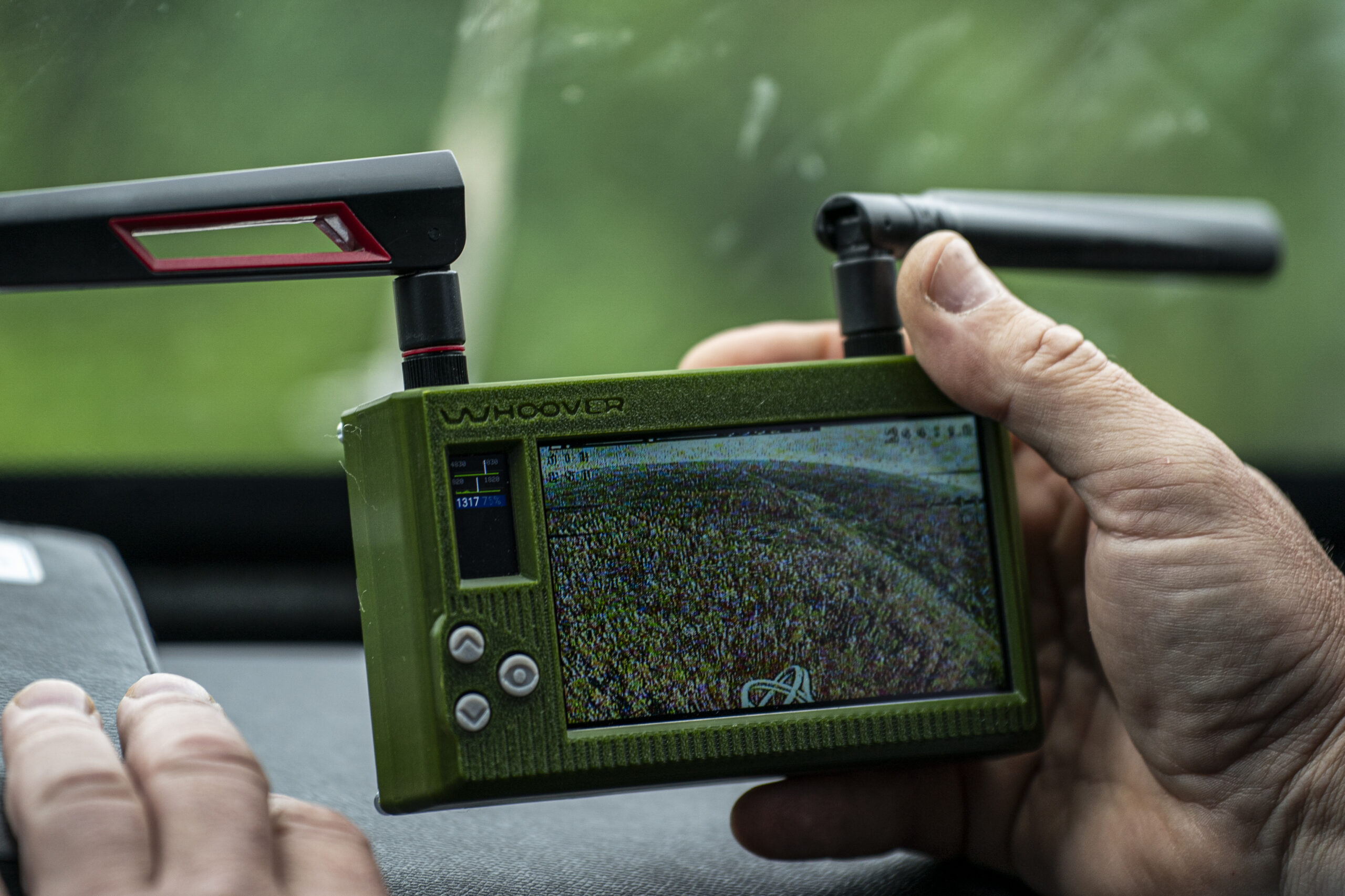
The most urgent addition has been drone detectors, otherwise known as frequency analyzers: small devices that scan for drone signals and deliver real-time alerts. The analyzers don’t jam the drone or transmit information—preserving the humanitarian principle of neutrality that keeps aid workers alive and minimizes the odds of putting a target on their backs. Since then, drone detectors have helped save many lives in Ukraine.
In one instance in Kupiansk, a drone detector enabled a humanitarian evacuation team to detect an incoming drone, get team members and civilians to safety, and prevent casualties—a stark contrast to what the outcome might have been without that early warning. As NP's Head of Mission in Ukraine, Anastasiya Marchuk, warns: "The data from Kherson, Kramatorsk and Kharkiv tell the same story: short-range drones are reshaping the battlefield and the risks civilians face. If we do not match that evolution with protected, coordinated evacuations, the fifth year of this invasion will see even more families trapped, injured or killed as they try to flee."
These lessons go beyond Ukraine. Local responders in Sudan, the DRC, Iraq, and elsewhere where similar threats are spreading deserve the same protections. We have learned how to identify those threats and adapt around them to stay safe, and so we have a responsibility to share those lessons.

The conversation we need
The United Nations Security Council convened in May for an open debate on the state of civilian protection in the world. The protection challenges posed by emerging technologies proved a primary thematic focus of the debate, second only to the need to reinvigorate respect for international humanitarian law, or IHL. The Secretary-General's protection of civilians report released earlier in the month had shared with member states that drone attacks in conflict settings increased by at least 4,000 percent between 2020 and 2024. The report also said that artificial intelligence has reportedly been used to support target identification in Ukraine and the Palestinian Territories, raising serious concerns about loss of human oversight, accountability, and the application of such systems in densely populated areas. While there's a clear need to reexamine legal frameworks that account for these violations, more can be done.
Now is a key moment in the international community to move away from the technological appeal of drone warfare and to focus on their responsibility to confront its nefarious impacts on civilians globally. Practically this means shedding light on the underfunded, largely invisible work local actors do to build protection systems that can keep pace with rapidly evolving war technologies and adapt those systems to counter that harm.
Drones are changing warfare. That is the story everyone is writing. Here is the one they are not: civilians were already living in an era where the rules meant to protect them are routinely ignored; modern conflicts have become increasingly dangerous for those caught in them. Now, drones are drastically and unpredictably escalating that harm in conflict zones, making an already dire reality even more lethal. And the humanitarian response to that in most places is still far behind. We have the technology to keep people safe—we cannot let the technology of war keep outpacing the technology of protection.
Joachim (Yomi) Kleinmann is Head of Programs for Ukraine at Nonviolent Peaceforce (NP), a global civilian protection organization working in conflict zones.