




Inside Nonviolent Peaceforce’s Civilian Protection Work in Ukraine
Source du clip de presse : Smiley Movement
Auteur: Cheyanne Bryan, Editorial and Campaign Marketing Executive, London
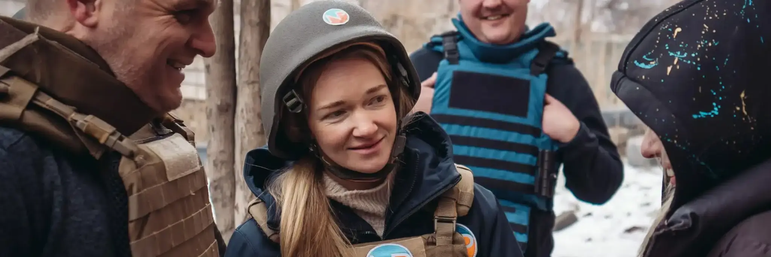
When most of us picture aid in a war zone, we think of trucks of food parcels and hygiene kits. But Nonviolent Peaceforce brings something far less tangible, but just as vital: people who show up, day after day, and stay.

“What don’t I do?” laughs Anastasiya Marchuk during an interview with Smiley News we ask about her role as Head of Mission for Force de paix non violente (NP) in Ukraine.
NP first arrived in spring 2022 with a three-person visit to work out where an organisation like theirs could help. Today the programme has around 74 staff across five locations in the south and east of the country, close to the active front line. Most of the team are Ukrainian, alongside 14 international colleagues, and they live in the same communities they serve.
That proximity matters. The UN’s human rights monitors recorded more civilians killed in Ukraine in 2025 than in any year since 2022, with frontline towns and short-range drone attacks driving much of the harm.
What is unarmed civilian protection?
NP’s approach is called protection civile non armée (UCP), and Anastasiya says its foundation is simple: relationships.
“We believe that communities have a lot of capacity and inherent mechanisms for self-protection, but they require support to strengthen them,” she explains.
On a typical day, that might mean being physically present at transit sites for people fleeing the fighting. The day before our interview, NP’s Kharkiv team accompanied an evacuation bus from a frontline location to the train station. They started at 8.30am and were not back at base until after 9pm.
“All that time they spent with the civilians currently moving away from dangerous locations to safer parts of Ukraine,” Anastasiya says. The team made sure everyone had equal access to services, that people with additional needs were supported, and that anyone with underlying vulnerabilities was referred on to specialist help.
She is honest that protection work can be harder than handing out supplies. “People are much more likely to open up to you if you are bringing something tangible,” she says. NP’s teams instead deal with deeply sensitive issues, including conflict-related sexual violence and child protection.
“To talk with community members in a trustful manner, you have to build that relationship,” she says. “You show up day after day, making sure they know they can rely on you, that whatever they share is confidential, and that you will actually do something about it.”
Backing the people on the front line
A huge part of NP’s work is supporting local organisations. More than 100 Ukrainian groups now receive what NP calls duty of care support, protecting the mental and physical wellbeing of the humanitarians doing the most dangerous jobs.
That support has become increasingly practical as the threat from drones grows. NP has rolled out frequency analysers to help frontline responders detect incoming drones, and backs a consortium of local evacuation crews through its STEEL project.
Anastasiya stresses that NP does not arrive with all the answers. “We, as an international NGO, are not coming to tell people what to do or with the assumption that we know better,” she says. “We come with resources and previous experience, but also an open mind.”
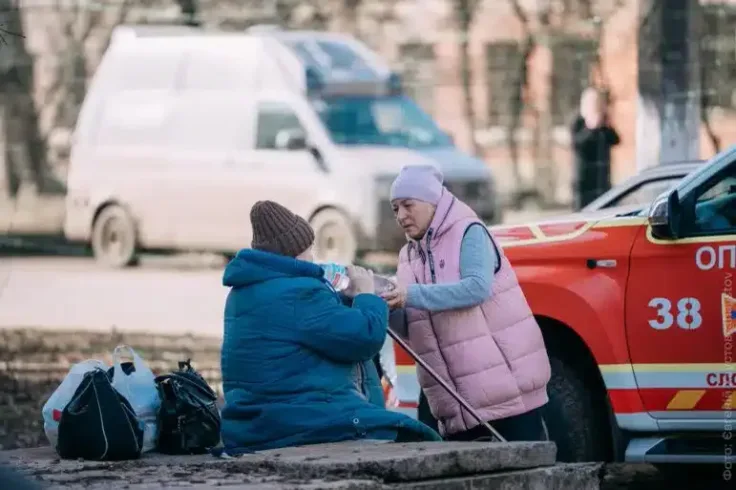
She is also clear about the limits. “We can’t stop the missiles from falling. We can’t stop the drones from flying,” she says. What NP can do is help communities prepare for emergencies, make safer choices, and set up longer-term structures such as community protection teams.
There is a quieter kind of harm, too. Long wars tear at the social fabric, and NP runs programmes to reconnect parts of society that have experienced the war very differently. The aim is to lay foundations for peacebuilding when the fighting ends.
From a theatre basement to 400 humanitarians
When the full-scale invasion began, Ukraine saw a wave of grassroots solidarity. Her favourite example? An amateur fishing club that decided, almost overnight, to start delivering aid to frontline communities.
Then there is the Relief Coordination Centre (RCC) in Kharkiv. When NP colleagues met them in 2022, they were around 10 people in a basement, all former theatre actors, “trying to figure out what all this humanitarian action is about.”
Today RCC has more than 400 people. It manages transit sites, leads coordination bodies and works hand in hand with other evacuation actors. It is now NP’s lead local partner, running a shared hotline and dispatch system for evacuation requests.
“They are basically the future of humanitarian action, and beyond that of solidarity action in Ukraine beyond the war,” Anastasiya says. “It makes me feel quite comfortable about the future of Ukraine.”
The aid world often talks about “localisation”, handing power to local organisations. For Anastasiya, RCC is that idea in action: “Local actors born out of necessity, who have taken a very conscious effort to build themselves up and take the lead, not just follow internationals.”
Maintaining optimism through crisis
So what keeps her going? A refusal to give in to isolation and self-interest, even when times are tough everywhere.
“Maintaining that positive and moral outlook is really important, because this is how we can collectively make those dark times go away,” she says.
“Some will say it’s very naive,” she adds. “But you know, call me naive every day, but I’ll stand by that.”
How to help
Anastasiya’s message is that solidarity is something everyone can offer. Here’s how to get involved:
- Read the stories: Visit the Nonviolent Peaceforce website to hear from teams in Ukraine and NP’s other country programmes.
- Become a regular supporter: A monthly gift helps NP plan long-term protection work with communities. You can donate via the NP website.
- Follow, like and share: “That’s a really great support when we know we are visible,” says Anastasiya. Following NP on social media shows decision-makers that people care about civilian protection.
Charity check-in
At Smiley Movement, we like to elevate the work of charities across the world. Here are three organisations backing local people in conflict and supporting families affected by the war in Ukraine:
Peace Direct. A London-based charity that funds and amplifies local peacebuilders working in some of the world’s most challenging conflict zones. Find out more.
Razom for Ukraine. A New York-based nonprofit, founded by Ukrainian and Ukrainian American volunteers in 2014, that delivers medical aid, invests in grassroots NGOs and advocates for Ukraine. Learn more here.
Voices of Children. Ukraine’s largest foundation providing psychological support to children affected by war, through regional centres and a free helpline. Support them here.
Envie de recevoir des histoires de paix dans votre boîte mail ?
Découvrez les dernières actualités, les événements à venir et les nouvelles opportunités d'agir.