
Peace Is Not Passive: This Young Bentiu Man Tells Us How
This year's International Youth Day theme, “Different Contexts, Common Aspirations”, emphasizes that despite the variety of challenges youth are facing globally, they all share common aspirations, such as access to opportunity, meaningful participation, decent work, and quality education. Across our country programmes, we've noticed that youth have another shared interest: cultivating peace.
By Mahmoud Shabeeb, Global Media Advisor, Nonviolent Peaceforce.
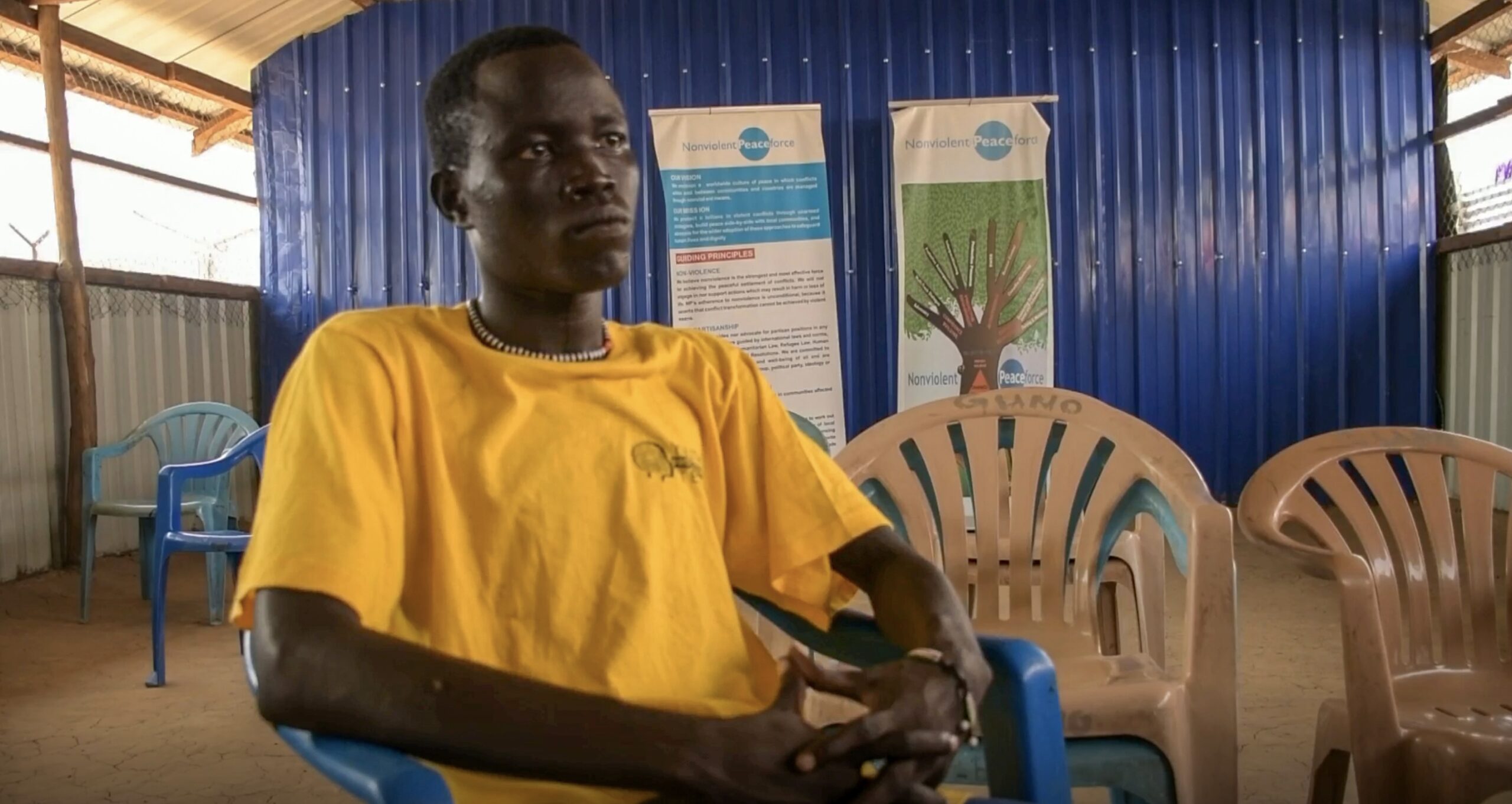
Nhial is from Bentiu and lives at an IDP (Internally Displaced People) camp. He’s been living at the camp since childhood, following the displacement of his family as the result of the country-wide conflict. Hearing directly from young peacebuilders like Nhial helps bring their experiences and perspectives into conversations where they are too often left out.
How War Changed Nhial's Childhood
Nhial Gatluak was ten years old when the life he knew ended overnight.
His family lived in a comfortable house in Bentiu in the north of South Sudan. His relatives held steady government jobs. There was school, food on the table, a sense of order and safety. Nhial had seen aid vehicles moving through town but had no real idea what they were for. And for some time, he did not need to know.
Then, in December 2013, war broke out, and Nhial found out the hard way.
Now 24, Nhial recounts how he fled into the bush with his family, running with whatever they could carry, and spent weeks there without food, water, or proper clothing. "The majority of them did not survive," Nhial says about his family members, recounting the horrors of that time. Some relatives were killed, others died of hunger, disease, or untreated wounds from walking barefoot through the forest. Those who made it out eventually found their way to a displacement camp on the outskirts of Bentiu.
Encountering Nonviolent Peaceforce
It was there, as a frightened child, that Nhial first encountered Nonviolent Peaceforce (NP). “The NP team members were cooking for children in the camp, giving kids a few hours each day to play and forget the stress outside,” says Nhial. He also remembers NP workers working diligently around the clock to register unaccompanied children, tracing their scattered families, and reuniting them, confirming each match carefully before bringing a parent and child back together.
"That is where I came to know Nonviolent Peaceforce," he says. "It all goes back to my childhood, to NP looking after us, and reunifying my friends with their mothers."
By 2015, NP had formed Women's Protection Teams that moved from block to block across the camp, raising awareness on child protection and spreading messages of peace. Nhial watched them for years before joining officially in 2022 as a member of NP's Youth Protection Team.
Vital and Necessary Work
That camp, now one of the largest displacement sites in the country, has grown far beyond what anyone expected when it was first set up. It shelters well over 100,000 people today, many of whom, like Nhial, have known no other home for their entire adult lives. Recurring floods since 2019 have made returning to their villages all but impossible, submerging farmland and forcing thousands more into the camp.
Although the fighting that first drove people out of their homes and into Bentiu’s displacement camp has eased, tensions continue from time to time, with fighting, sexual harassment and assault, looting, and other forms of insecurity making people’s living conditions continuously challenging, day in and day out.
For all these reasons and more, NP’s Youth Peace Teams’ work, like Nhial and his friends, is vital and necessary, and he knows it.
Youth team members patrol not only by day, but at night when the groups locally known for negative influence over young people are most active. Rather than confront them, Nhial's team relies on dialogue, explaining the toll such behaviour takes on the community and on the young people's own standing within it. He says the approach is beginning to shift things: some members of these groups have started approaching the youth team themselves, asking to join.
The team's mandate does not stop there. They work to reduce child and early marriage, encouraging families to keep their daughters in school rather than pressure them to get married, particularly in cases where an unintended pregnancy might otherwise force a marriage to someone other than the child's father. They also mediate disputes among young people, drawing on shared experience and generation to reach the people whom camp elders often cannot reach.
The Challenge of Shrinking International Aid
Nhial is candid about the strain of sustaining this work as international support has dwindled dramatically over the last few years. But he describes the motivation as something rooted closer to home than any programme funding. "We should not need to be supervised to do our own work, which we have been doing as community members," says Nhial. Despite gaps in mentorship that result from decreasing numbers of aid workers in the camp due to increasing funding cuts, Nhial commends the many who have stayed involved without pay, simply because they consider themselves part of the community they serve. “NP's early investment in that team is the reason it still exists at all.”
Among all the challenges South Sudan is facing, one of Nhial’s biggest concerns is the cost of a peace agreement that keeps fraying. “Young people in South Sudan are dying to drug abuse, to violence, to the absence of the basic security that would let a country function normally, one where school fees would not be an obstacle, farming would be safe again, and families would not depend on daily food distributions to survive.”
Being a peace advocate himself; peace is top of mind for Nhial. "We are tired of being confined in one area for more than 13 years," he says. His message to those in power is simple: take the peace agreement seriously, and do not let it be violated again.
* * *
What is a Youth Protection Team?
At NP, Youth Protection Teams (YPTs) consist of young women and men, between 16 and 25 years old, who have been trained by our staff in Unarmed Civilian Protection (UCP), including nonviolent communication, conflict management, sexual and gender-based violence (SGBV) prevention and response, and positive masculinities.
Collectively, they strive to identify community concerns and work with community leaders to develop locally-driven solutions. While being on the YPT requires a two-day per week commitment, they often exceed this, as the youth frequently receive assistance requests from their communities, and they’re eager to offer support.
Nonviolent Peaceforce has supported the establishment and sustainability of 27 Youth Protection Teams across South Sudan, through training, mentoring, and cooperation on joint activities.
--> Relacionado: Empoderamiento de los jóvenes y fortalecimiento de la protección en Pibor