



Sorghum & Safety in Baliet
Continued violence and increasingly extreme flooding in the past few years means that South Sudan has one of the five largest internally-displaced populations from conflict and natural disasters.
In response, Nonviolent Peaceforce teamed up with Solidarités International to support the protection and resiliency of these communities.

“We have been suffering due to floods,” shared Ajak,* the Payam Administrator (local official) from Baliet, a small-scale farming and livestock county in Upper Nile, South Sudan.
“We did not harvest anything this year from the sorghum we planted. Therefore, we are surviving from the humanitarian aid.“ Ajak mentions that the aid is not enough.
In Baliet and throughout South Sudan, sorghum crops have long been a staple. The high rains and subsequent floods over the last three years had caused agricultural damage and loss, as well as the relocation of the people. Local farmers have struggled with production, increasing food insecurity and community tensions. At times violence has broken out as a result.
But the community hasn’t had the capacity to address these tensions. People have been scrambling to make a living amidst a difficult situation of food insecurity resulting from floods.
In response to the interrelated conflict, flooding, and displacement in this part of South Sudan, Nonviolent Peaceforce (NP) and Solidarités International (SI) have teamed up to strengthen independent, community-based initiatives. Together, NP and SI have started working to support communities like Baliet in preventing violence, building peace, and promoting gender equality, protection, and social cohesion.

Baliet is home to a warm and welcoming Dinka community. Initially drawn to the NP uniforms’ neon orange and the SI uniforms’ highlighter yellow, community members—children, youth, women, and men alike—rushed to welcome the teams upon their arrival via boat.
Since the road that runs directly to Bailet is only accessible during the dry season, the NP and SI teams traveled together via Pigi Canal on the Nile River.
Most of the organizations already in Baliet had been focusing on water, sanitation, education, livelihood, or health. So community members were intrigued to see a new organization coming to their area who didn’t do this work, but was instead focused on peacebuilding.
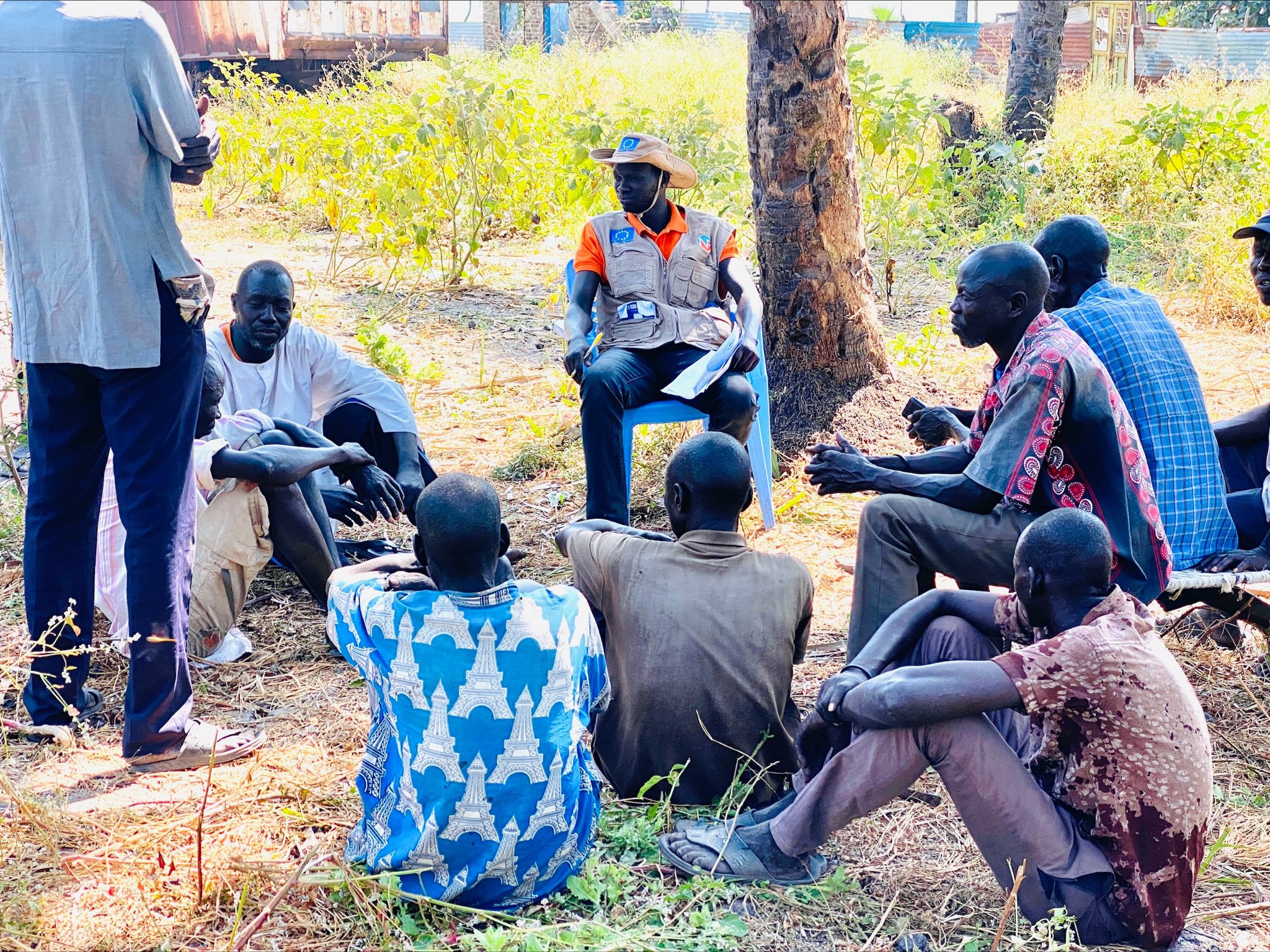
After the travel by boat, NP and SI had their first conversation with the community in Baliet. This starting point means that we can put connections and relationships at the center of our work.
During this initial conversation, when asked about what was top of mind, the community focused on getting safe and secure access to food, which had become scarce and more dangerous to access due to the floods and conflict. Many people shared that they were hopeful that peace in the state will prevail.
Ajak, the community, local leaders, SI, and NP will be building on these conversations and ideas – turning them into action for sorghum and safety. Together with local leaders like Ajak, our protection team will work alongside SI to build peace with and for the community.
* * *
Diese Aktivität ist Teil unseres Projekts mit Solidarités International (SI) zur Unterstützung der Widerstandsfähigkeit der Gemeinschaften und des gewaltfreien Konfliktmanagements in den von Konflikten und Überschwemmungen betroffenen Gebieten der Bundesstaaten Upper Nile und Jonglei im Südsudan. Finanziert wird das Projekt von der Europäischen Union und Unterstützern wie Ihnen.
*name changed
Möchten Sie Friedensgeschichten in Ihrem Posteingang erhalten?
Entdecken Sie die neuesten Updates, bevorstehende Veranstaltungen und neue Möglichkeiten zum Handeln.