
Civilian Harm Escalates as Ukraine Marks Four Years of Full-Scale Invasion
New NP report warns drone warfare is driving surge.
23 February 2026 — Odesa, Ukraine: Nonviolent Peaceforce (NP) warns that escalating drone warfare is driving latest steep rise in civilian deaths and other harms, while putting frontline volunteers at extreme risk, as Ukraine marks the fourth anniversary of Russia’s full-scale invasion. The organisation’s new impact report on the “Safe Transport for Emergency Evacuations and Logistics” (STEEL) consortium-led efforts shows that while locally led armoured evacuations are saving lives under fire, they remain dangerously under resourced just as needs are growing.
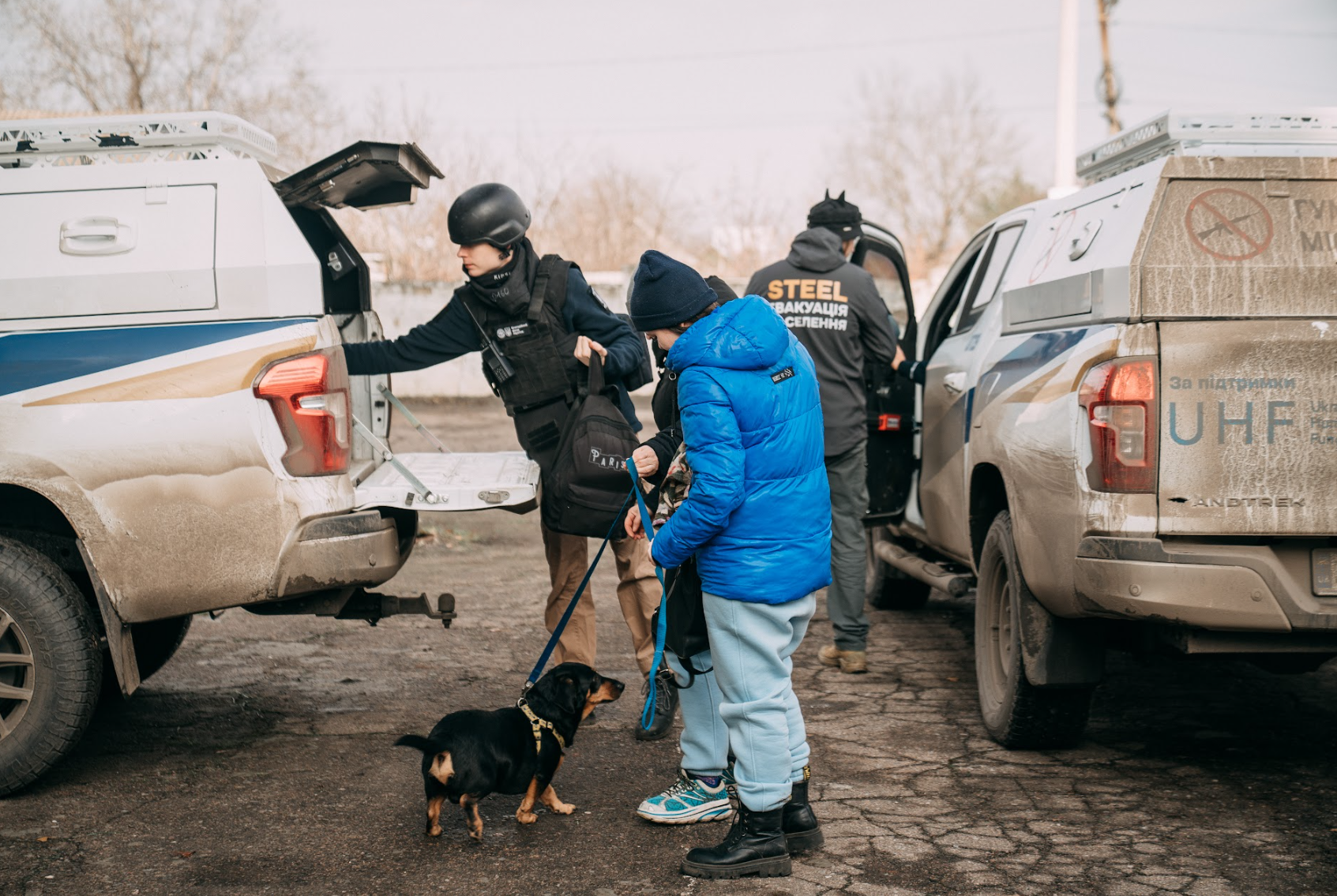
“Four years into the full-scale invasion, civilians in frontline communities are living under the constant threat of short-range drones and artillery,” said Anastasiya Marchuk, NP’s Head of Mission in Ukraine. “Our partners are still driving into bombardment so that others can get out. The least the world can do is ensure they are not doing it in unprotected vehicles with failing radios and no spare parts.”
Drawing on 261 interviews with evacuees and twenty surveys with local partners, the report details how evacuation teams, mainly comprised of volunteers, have evacuated 922 civilians from frontline communities in Kharkivska, Donetska, and Sumy oblasts in the last two years. Older people, persons with disabilities, and families who had endured months of shelling make up a large share of those assisted, many leaving with only minutes to prepare.
Information taken from INSO’s Conflict & Humanitarian Data Centre (CHDC) included in the report shows a dramatic rise in short-range UAV strikes and corresponding civilian casualties in multiple regions between 2023 and 2025. NP therefore warns of an accelerating humanitarian cost of drone warfare, including on some of NP’s partners in the STEEL consortium, with the latest drone attack happening last week against a STEEL member in the Donetsk oblast.
The STEEL consortium brings together seven local organisations operating armoured pickup vehicles and ambulances in some of the most exposed areas of eastern Ukraine. Relief Coordination Centre (RCC), NP’s lead local partner, runs a shared hotline and dispatch system, assigning evacuation requests across the consortium and planning missions with regional authorities and the National Police. Each mission is carefully mapped, from routes and transfer points to contingency plans if shelling or drone activity suddenly intensifies.
“Volunteers will go to the frontline regardless, then why not go as safely as possible?” said Yevhen Koliada, Head of RCC.
Behind the statistics are civilians who resisted leaving until the danger became unbearable. Iryna, 68, stayed home in Kupiansk despite repeated strikes. “From one day to another, I had to leave my home. I did not know what to bring, who would take me, where they would drop me,” she recalled at a collective site in Kharkiv. “There were too many strikes. I did not want to leave. When evacuations team came, I had only 10 minutes to pack everything and leave.”
The report chronicles similar stories from Sumy and Donetska oblasts, where people like Yuliia and Viktoriya only agreed to evacuate after months of bombardment, loss of basic services and repeated conversations with volunteers.
“These evacuations are not just about getting people from point A to point B,” Marchuk said. “They are about trust. People are leaving their homes, belongings and memories behind, often with no guarantee of when or whether they will return. Our partners have to read fear, listen to doubts, explain the risks honestly and still keep moving before the next shell lands.”
The report findings reveal both the protective power of armoured vehicles and trained local crews, and the mounting risks they face as shortrange unmanned aerial vehicle (UAV) attacks intensify. The report also offers a cleareyed assessment of gaps that must be addressed if STEEL and similar models are to keep pace with the war.
With the sharp rise of civilian casualties, Nonviolent Peaceforce and its partners are now extending the STEEL modality to more regions in southern Ukraine, where the consortium will be led by the local organisation Bridge of Unity.
“The data from Kherson, Kramatorsk and Kharkiv tell the same story: shortrange drones are reshaping the battlefield and the risks civilians face,” Marchuk said. “If we do not match that evolution with protected, coordinated evacuations, the fifth year of this invasion will see even more families trapped, injured or killed as they try to flee.”
NP urges donors, authorities, and international partners to actively invest more in protected evacuation capacity in Ukraine, including armoured vehicles, drone mitigation, robust communications systems, sustained and recurring training for crews, and strengthened accessibility and outreach.
About Nonviolent Peaceforce:
Nonviolent Peaceforce (NP) is an international nongovernmental organisation deploying Unarmed Civilian Protection (UCP) tools to safeguard lives in conflict zones. Our mission is to protect civilians through unarmed strategies, build peace alongside local communities, and advocate for wider adoption of nonviolent protection in order to safeguard human lives, safety, and dignity.
For media, contact: Mahmoud (Moody) Shabeeb, Global Media Advisor, at [email protected]