
Trailblazing peacekeeper awarded Honorary Doctorate
Press Clip Source: Aberystwyth University
Link to Source: Here
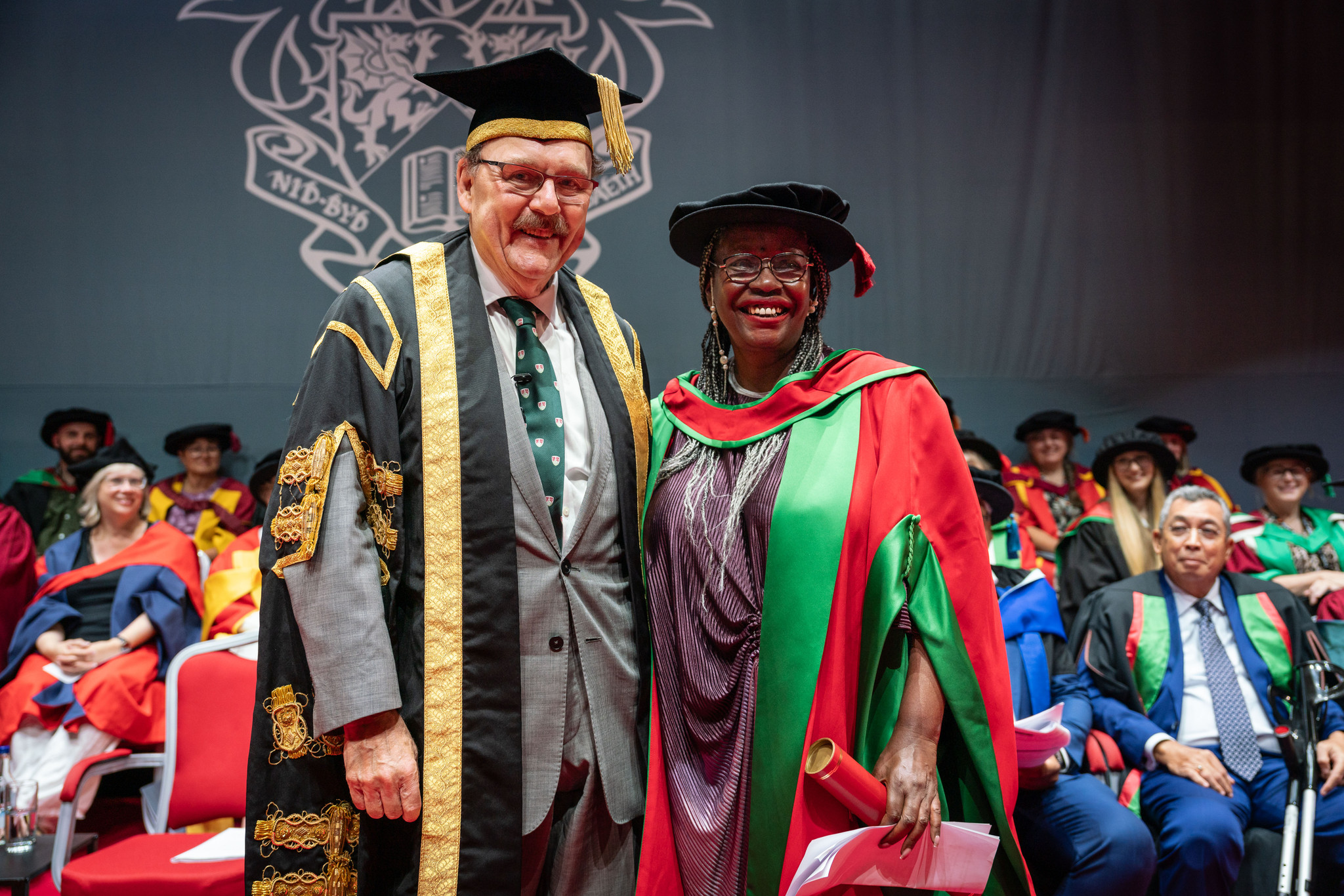
Peacekeeper Rosemary Kabaki has been awarded an Honorary Doctorate by Aberystwyth University.
She is the Head of Mission at Nonviolent Peaceforce in South Sudan. She previously worked with Nonviolent Peaceforce in Myanmar as Head of Mission, in the South Caucasus as a Human Rights and Civilian Protection Expert, and in the Philippines as an International Civilian Peacekeeper.
She has experience working in Kenya in both the nongovernmental organisation and civil service sectors.
Rosemary Kabaki was presented with an Honorary Doctorate by Professor Berit Bliesemann de Guevara on 15 July.
The full conferral presentation is available below, in the language in which it was delivered.
Presentation of Rosemary Kabaki by Professor Berit Bliesemann de Guevara
Ddirprwy Ganghellor, Ddirprwy Is-Ganghellor, graddedigion, gyfeillion. Pleser o’r mwyaf yw cyflwyno Rosemary Kabaki i dderbyn gradd Doethur er Anrhydedd, Prifysgol Aberystwyth.
Pro Chancellor, Pro Vice-Chancellor, graduates and supporters. It is an honour and a privilege to present Rosemary Kabaki with an Honorary Doctorate of Aberystwyth University.
The research conducted at Aberystwyth University explicitly aims to “change lives for the better”, and I couldn’t think of anyone embodying this vision better than Rosemary Kabaki, who has made an outstanding contribution to the nonviolent protection of tens of thousands of civilians living in the middle of armed conflict in East Africa, Southeast Asia, and Europe.
Rosemary is the Head of Mission in South Sudan and former Head of Mission in Myanmar of Nonviolent Peaceforce, an international nongovernmental organisation whose mission is “to protect civilians in violent conflicts through unarmed strategies and build peace side-by-side with local communities.” Previously, she worked as a Human Rights and Civilian Protection Expert in the South Caucasus, with NGOs and the civil service in her native Kenya, and as a Psychology lecturer at Kenya Medical Training College.
Most importantly, in these roles Rosemary Kabaki has embraced research as a strategy to grow knowledge of unarmed civilian protection and to engage in a continuous learning process about nonviolent conflict resolution with conflict-affected communities. She has done so by collaborating with researchers from different universities around the world, including Aberystwyth University, where she collaborated in the International Politics department’s “Creating Safer Space Research Network”, and by integrating Participatory Action Research into unarmed civilian protection work. I just had the pleasure to help train members of the community of practice of unarmed civilian protection in South Sudan in such community-based research strategies, and we are also waiting for results of a joint research application to set up the very first comprehensive database to quantitatively measure the effectiveness of unarmed civilian protection, starting with data from South Sudan.
This honorary doctorate is a unique opportunity to honour an individual who has made a real difference to protecting people from harm and death in contexts of conflict around the world and changing tens of thousands of lives for the better.
Ddirprwy Ganghellor mae’n bleser gen i gyflwyno Rosemary Kabaki i dderbyn gradd Doethur er Anrhydedd, Prifysgol Aberystwyth.
Pro Chancellor, it is my absolute pleasure to present Rosemary Kabaki with an Honorary Doctorate of Aberystwyth University.
Rosemary Kabaki, Honorary Doctorate Speech Transcript

4 min 52 secs | Pro Chancellor, Pro Vice Chancellor, Dr. Berit (whose last name I can’t pronounce), distinguished faculty, graduates, families, and friends, asante sana. Thank you very much.
I am deeply honoured to receive this Doctorate from Aberystwyth University. I want to acknowledge, too, that this recognition belongs as much to the communities I have worked alongside for the last two decades- in Kenya, in the South Caucasus, across Asia, and currently in South Sudan- as it does to me. They are the ones who have taught me what protection really means.
5 mins 37 secs | It is my absolute privilege to work Nonviolent Peaceforce's mission in South Sudan. Nonviolent Peaceforce is built on a simple, but radical idea: that unarmed civilians can protect other civilians caught in violent conflict not with weapons, but through presence, relationships, and trust.
Some might think it impossible, but Nonviolent Peaceforce has proven that this radical idea works, time and again, for over two decades, and counting. And I’ve been privileged to see that.
6 min 18 secs | Unarmed Civilian Protection works through presence. Our teams live in the communities they serve, they don’t live in compounds behind walls. The relationships we build for trust are with local leaders, women's groups, youth, displaced families, and yes, even those carrying weapons, because dialogue is how you prevent the next attack. Not just in responding, but preventing the next one.
Early warning sounds complicated really, but sometimes it is so often a phone call, or even a woman walking two kilometres to tell us that her community has armed actors around her town, and that stops something terrible from happening.
It is not the absence of danger. It is protection from building relationships, not from force.
7 min 18 secs | [There’s] one moment that has stayed with me and I would love to share [it] with you today: earlier this year, we had communities (we call them Community Protection Teams) sharing that there were many armed actors around them and that violence was imminent. The Community Protection Teams went and negotiated with armed actors from both sides and created corridors for the civilians, the women, the children, some of the youth, people with disabilities, to be evacuated from where the violence was about to happen. And violence did happen. But some of those civilians that were evacuated are part of some of the 400,000 civilians that managed to move from there, and their lives were saved. To be honest, some of them had to go to [relocate to] Ethiopia from South Sudan, walking [on foot].
That is Unarmed Civilian Protection. It’s not a theory, but rather a relationship built long before the danger happens.
8 min 25 secs | I say this because civilians in conflict are so often spoken about only as numbers, or as victims. They are neither. They are protectors, first responders, and the first researchers of their own reality, and that has shaped how we work.
This is also why my relationship with Aberystwyth University, and with Dr. Berit in particular, has mattered so much to me. Dr. Berit made research stop being a big scary academic thing that is done somewhere out there.
And through the Creating Safer Space research, we learned how to work together with the researchers. We worked out how we could fit into the research work and how our work is important enough to fit into the research.
9 min 23 secs | Our community members, us, through participatory action research have researched why they have conflict in their own country, when it manifests into violence, and what they do and can do more of, to reduce this violence.
So therefore, research has become not an add-on to our humanitarian work, but a real big part of the work that we do. I’m going to put in the next, because, my daughter, many years ago, forced me to watch Buffy the Vampire Slayer over and over, over and over, and over again. And one of the things that struck me about Buffy the Vampire Slayer, was actually in the last season that we watched—where Buffy talks about (and I’m going to paraphrase) how the power she has, she passes it on to anyone who can have that power. So if I may paraphrase that, that any civilian that can protect, should protect. Because we, all us, are protectors.
10 min 35 secs | Dr. Berit’s talked about the research we’re about to do next. It’s so exciting that there will be actual data for what we have been doing for the last 20 years and that it’s captured for us to see what’s working, why is it working, why is it sometimes not working, and what could we do differently.
10 min 58 secs | Civilians in conflict zones are not waiting to be saved. They’re waiting to be partnered with long enough to save themselves, and each other. This is the work and this is the honour that I carry with this presentation.
11 min 15 secs | I would like to take a moment to recognize the people who have worked with me on this journey. My siblings over here, who have accompanied me, will recognize why I put my father, [inaudible first name] Kabaki, as the first person I would like to recognize. Over 50 years ago, he had a vision. And I see him right here, because this [work], he did 50 years ago (not that I want to age myself). I would also like to thank all my friends and colleagues of Nonviolent Peaceforce. Unarmed civilian protection believes you don’t do it yourself, you do it with as many people as possible. And all my friends and colleagues of Nonviolent Peaceforce, Creating Safer Spaces, my beloved family and my friends. Thank you so much.
Aberystwyth University Honours 2026
Each year, Aberystwyth University confers Honorary Awards on a small number of distinguished individuals in recognition of their outstanding achievements and contribution to their fields. More information about Aberystwyth University Honours 2026.