




Situational Awareness & Upstander Intervention
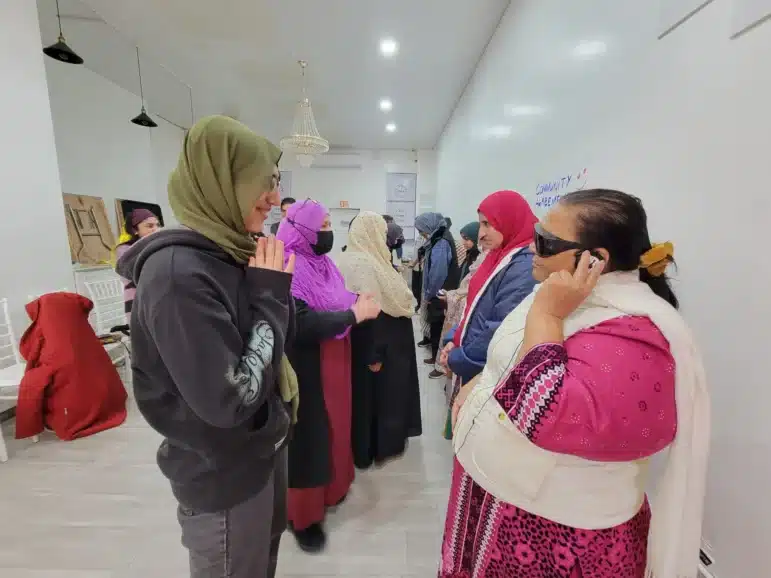
A group of women, some in scarves and traditional dress, stand and talk in a brightly lit room with white walls. One woman in sunglasses uses a phone. Chandeliers and wall signs are visible in the background.
Graphic of an urgent stickman. The words around them read "Situational Awareness and Being an Upstander Part 1. Situational Awareness: What? Why"

What is situational awareness?

Practicing situational awareness involves using all your senses and your body to assess your surroundings for potential threats and to develop a plan of action to keep yourself and others safe. These survival skills enable anyone to assess and navigate their environment. It involves understanding both internal and external factors and how to respond to threatening situations effectively.

Survival Responses & Tools
Graphic of a stickman surrounded by speech bubbles. Inside the speech bubbles are caution signs. The words say "Situational Awareness and Being and Upstander (Part 2). Survival Responses and Tools."
An Overview

Reflect on your go-to response when facing escalating scenarios.
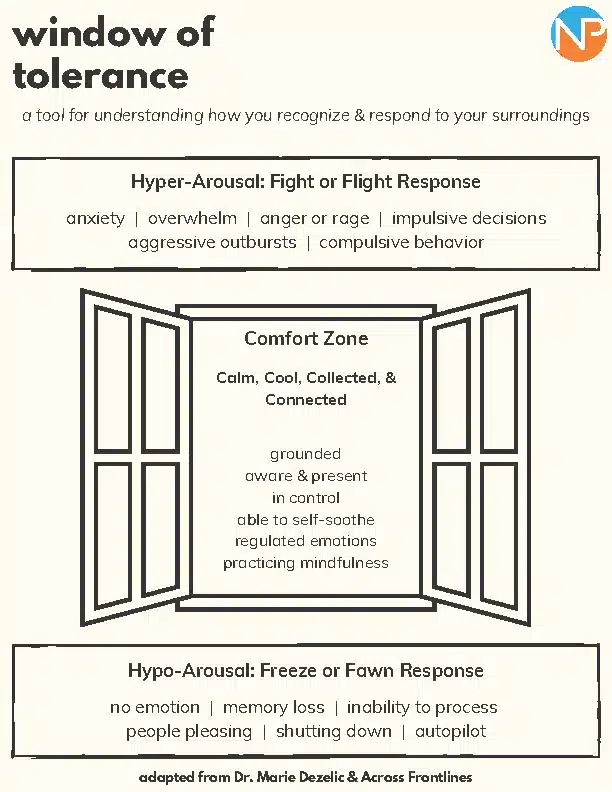
Infographic explaining the window of tolerance, showing three zones: hyper-arousal (fight or flight), comfort zone, and hypo-arousal (freeze or fawn), with related emotions and behaviors listed for each.
Window of Tolerance

understanding how you recognize & respond to your surroundings
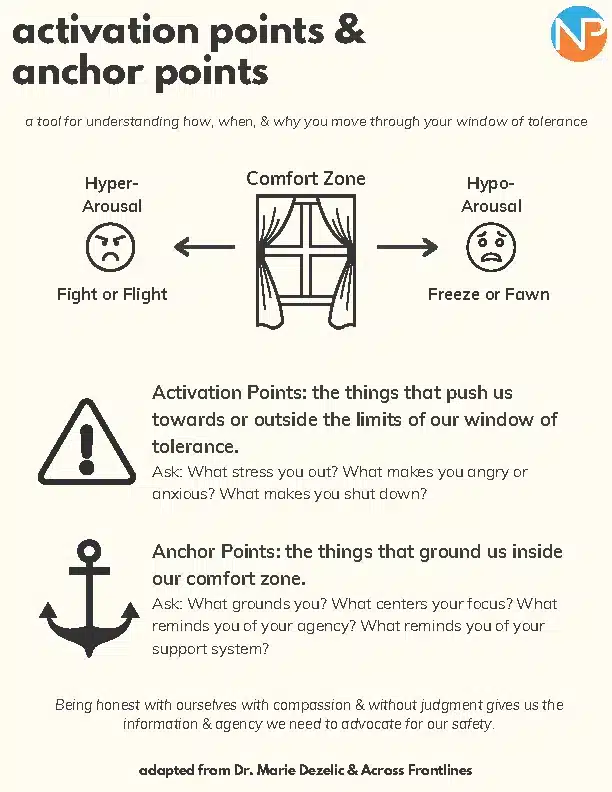
A diagram shows the comfort zone between hyper-arousal (fight or flight) and hypo-arousal (freeze or fawn), explaining activation points and anchor points for self-awareness and safety. Text and simple icons illustrate concepts.
Activations & Anchors 

how, when, & why you move through your window of tolerance

Anchoring Yourself

What makes you feel grounded, safe, comfortable, or grounds you back into your Window of Tolerance?
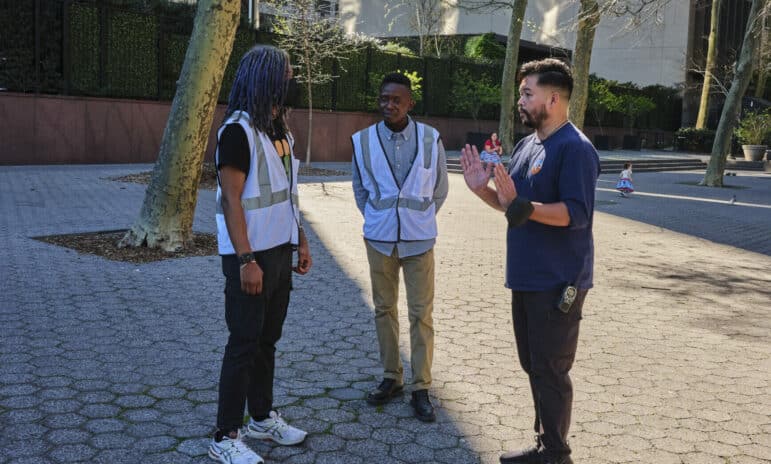
Three people, two wearing light gray safety vests and one in a navy shirt, stand outside on a paved area having a conversation near trees and buildings.

A community Care Tool

Holistic Check-In

Developed by Across Frontlines for human rights defenders, community safety teams, and frontline activists to employ when providing care after an action.

It’s one way to support someone to self regulate based on consent, community care and honoring their agency & autonomy.

A dark blue icon of a person with one arm bent across their chest, as if touching their heart, on a white background.
A simple icon of a person holding a heart over their chest, with six leaves arranged symmetrically around them, all in dark blue on a white background.
Icon of a person with three emotion faces above: happy on the left, neutral in the center, and sad on the right. The image represents a range of emotions or moods on a plain white background.
Icon of two hands clasped in a handshake or arm wrestling grip, with three lines above to indicate motion or emphasis, set against a plain white background.

OODA Loop

Graphic of a stick figure standing in the middle of a looped arrow. The graphics says: "Situational Awareness and Being an Upstander. Part 5. OODA Loop."
The OODA Loop:

sift through information and events
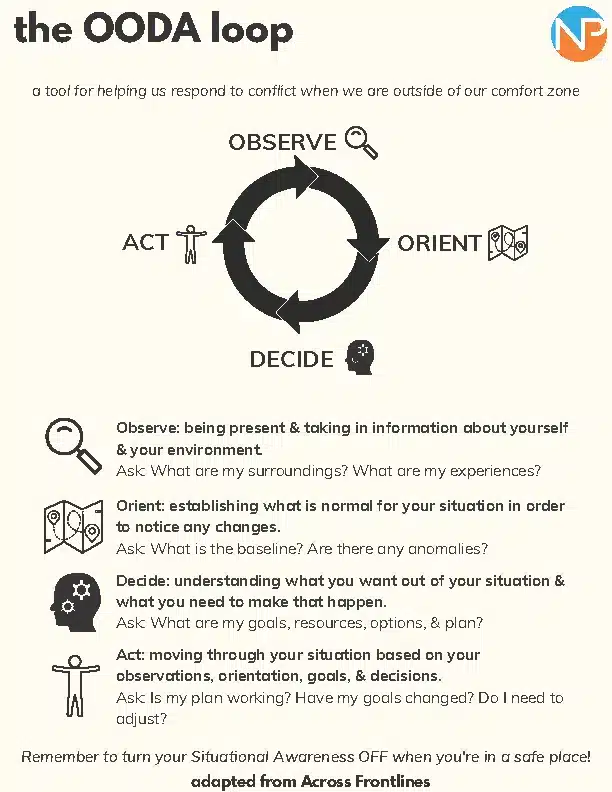
A diagram titled the OODA loop shows four steps in a cycle—Observe, Orient, Decide, Act—with icons and brief explanations of each step, providing a process for responding to situations.
The OODA Loop:

responding to conflict when we are outside of our comfort zone

A man with dark hair and a beard is speaking, holding up two fingers. Behind him are a white hard hat, some tools, and a poster. Text on the image reads, YOU ALWAYS WANT TO HAVE AT LEAST TWO EXIT..
For example:

identifying two exit routes

De-Escalation Tips
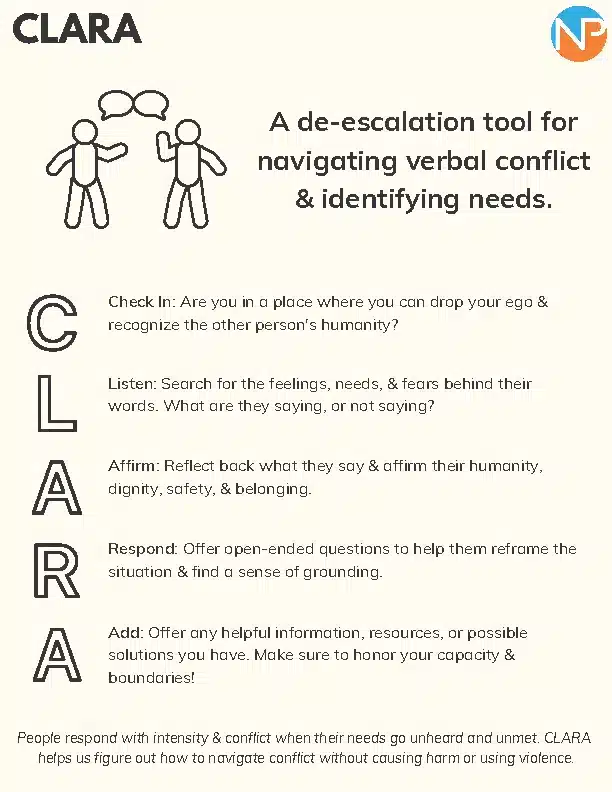
A handout titled CLARA: A de-escalation tool explains steps for navigating verbal conflict: Check In, Listen, Affirm, Respond, and Add. It includes brief descriptions for each step and a small logo in the upper right corner.
CLARA

A de-escalation tool for navigating verbal conflict & identifying needs.

Find de-escalation trainers & trainings near you

Equip yourself with the de-escalation and community safety skills to navigate conflict
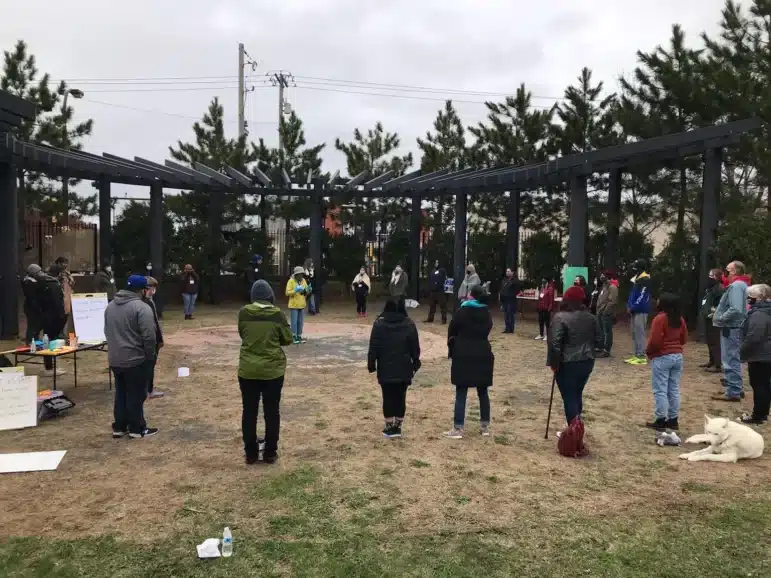
A group of people stand spaced apart in a circle on grass under a pergola structure, some wearing coats and hats. A few signs and supplies are on the ground. A white dog lies nearby. Trees and power lines are in the background.

The logo displays the text Nonviolent Peaceforce with Peace in bold white letters inside a blue circle, while the rest of the text is in blue on a light background.
Privacy Overview

This website uses cookies so that we can provide you with the best user experience possible. Cookie information is stored in your browser and performs functions such as recognising you when you return to our website and helping our team to understand which sections of the website you find most interesting and useful.