
Witnessing, Protecting, Resisting: Minnesota’s Nonviolent Approaches to Community Safety
Minnesota has become a flash point of an expanded Immigration and Customs Enforcement (ICE) operation that has deployed thousands of armed federal agents into the state, militarizing daily life and spreading widespread fear for safety and life among the community. This has involved repeated, documented instances of federal law enforcement using force against members of the community, including those seeking to illuminate their activities through witnessing and observation.
A surge in ICE operations across the US has led to violent escalations, including fatal shootings of three civilians in 2026 alone, Keith Porter, Renee Good, and Alex Pretti, prompting widespread protests. At the same time, ICE’s actions in custody have come under increased scrutiny: at least 30 people died in ICE detention in 2025, with six more deaths disclosed so far in 2026.
NP was founded in the belief that independent observation—trained, principled witnessing of state power—is essential to accountability and community safety, a tactic used from international human-rights missions to local election observers. That belief has taken on profound urgency: Both Good and Pretti were serving as civilian observers when they were shot and killed by federal agents in Minneapolis on January 7 and January 24, respectively.
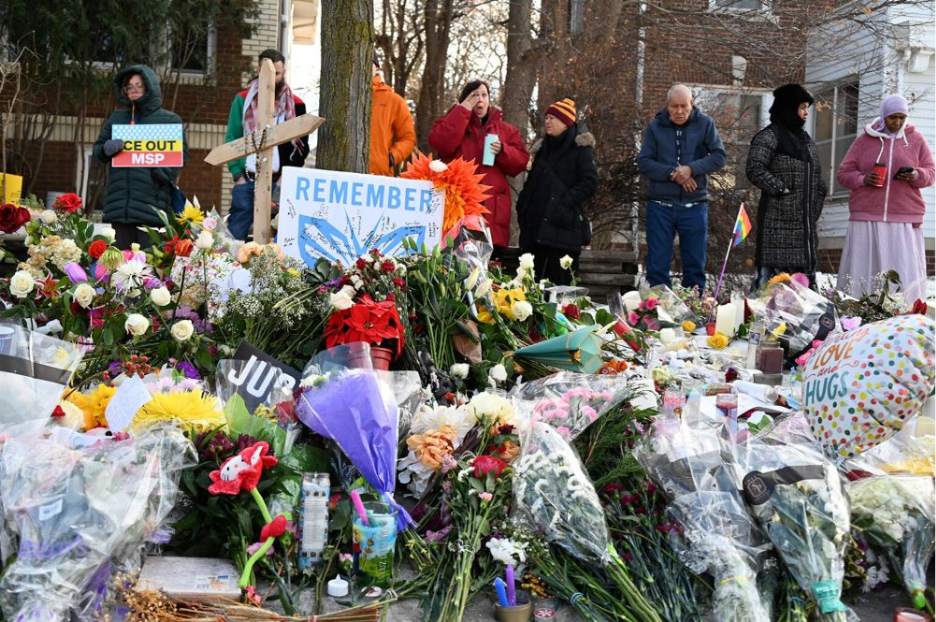
Photo: Clergy members sing the hymn "We Rise" at a memorial honoring Renee Good, who was fatally shot Jan. 7 by an ICE officer. Minneapolis, January 9. (RNS/Jack Jenkins)
Networks of Neighbors
The community response in the Twin Cities to the escalation of federal forces has been powerful and proactive. For months now, neighbors and local groups have been showing up for one another through protective presence—being physically outside schools and on busy street corners where ICE has increased and escalated its operations. And through accompaniment efforts, such as carpools organized for children whose parents don’t feel safe leaving their homes for fear of profiling. These acts of care and coordination are helping families navigate daily life with greater safety.
“For some community members, this was the first time they had ever taken part in a response like this. And for others this response is a part of a long history of organizing in the area” reflects NP’s Roz Lee. “What I heard over and over was the same thing: that community unity is their pride and joy—and something they are willing to show up to protect. That is why the community response is so strong.”
Thousands of neighbors, from retired school teachers and librarians to nurses and grandmothers, have poured their energy into early-warning and early-response networks. This has strengthened and expanded the systems organizers have had set up for years, especially during the uprisings following the murder of George Floyd.
“When I went out on a community-led patrol the other day, the partner I was with said, ‘I never thought in my life that I would have to have a gas mask,’” said Lee. “And yet there she was, stepping into the role with care and professionalism, doing what needed to be done to keep people safe.”
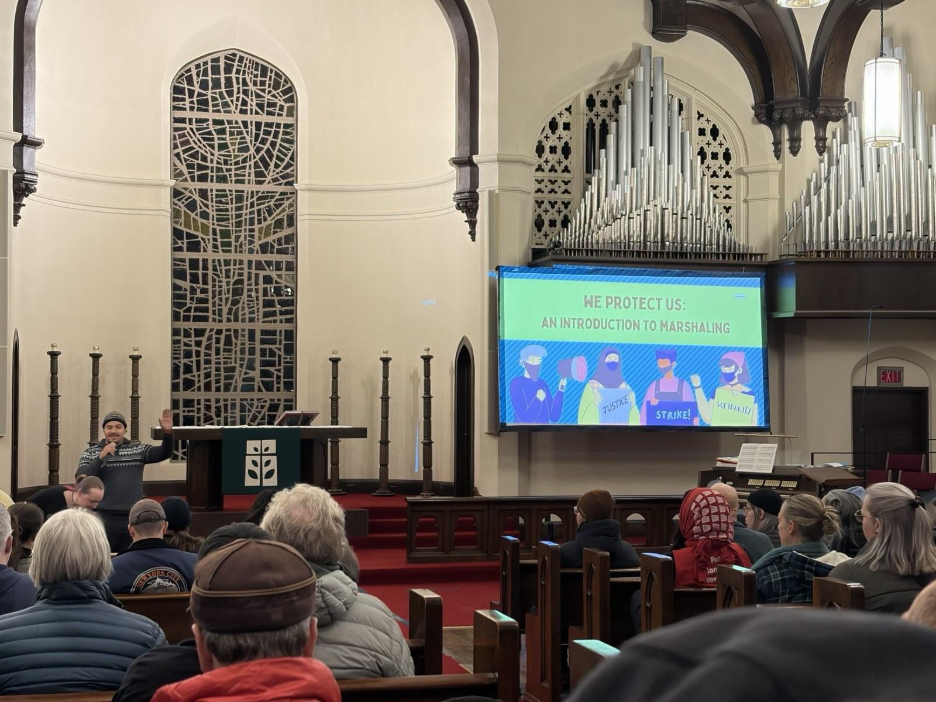
These networks of neighbors prepare and respond in real time, using group chats that alert neighbors about potential ICE sightings and movement of vehicles. Trained observers document federal activity so communities have reliable records of behavior and patterns, and so that people taken by ICE do not get lost in a detention center. Careful rumor control, such as verifying crowdsourced tips, helps ensure information is accurate, responsibly shared, and truly useful for keeping one another safe.
Safety and Civic Action
These community safety efforts—the grassroots unarmed civilian protection work of protective presence, accompaniment, early-warning systems, rumor control, and trained observers—don’t happen in isolation. They are deeply interconnected with one another and with other nonviolent strategies. People and organizations are coming together to provide holistic community care, including mutual aid, legal support, and other forms of coordinated solidarity.
And holistic community care strategies extend from schools and street corners to protests, woven into a strong tradition of civic action in the state.
“When tens of thousands of people come out for a protest or a rally, safety is crucial,” says NP’s Ethan Quezada. “While there are many trainings on de-escalation and protest safety, participants are understandably focused on the civic action itself. That’s why having people assigned solely to safety roles is so important.”
This is where NP’s approach comes in: our team is focused on strengthening the safety ecosystem that already exists. In recent weeks, union leaders have trained more than a thousand people to serve in protest safety roles. Building on that work, NP co-facilitated a protest safety training with union leaders ahead of the massive general strike on January 23. NP accompanied organizers as they prepared and carried out the action, providing our expertise along the way.
“NP has the privilege of working alongside communities around the world, and of carrying that shared wisdom into every place we show up,” shared Quezada. “After years of working with NP in Minnesota and San Diego, being able to bring those lessons home at such a critical moment—and seeing those lessons help keep thousands of people safe in real time—has been deeply meaningful.”
What Minnesota is Showing the World
This isn’t something for just Minnesotans to take immense pride in. This is a powerful example for communities everywhere who haven’t yet seen what visible community care, nonviolent action, and civil resistance can look like in practice. At a moment when fear and uncertainty can feel overwhelming, what’s unfolding in Minnesota offers hope grounded in action.
This is the work NP supports and strengthens. We train organizations and community leaders—like those highlighted here—to build safety ecosystems rooted in unarmed civilian protection, de-escalation, and collective care.
If you’re wondering what this looks like for you, start here: read these 3 essential resources for personal safety and community care to explore practical tips, watch this training video on self protection and nonviolent interventions, or find a community safety and de-escalation training near you.
This work arcs across years. People trained by and volunteering with NP in 2020 are still showing up today, putting community care into practice. And with more moments ahead, from the midterm elections to natural disasters, preparing now means we’re ready for our communities when it matters.