
Local Mechanisms of Protection: A Joint Policy Dialogue with Nonviolent Peaceforce and the Bahá’í International Community
Centering Communities in Protection: A Practitioner Dialogue in Addis Ababa
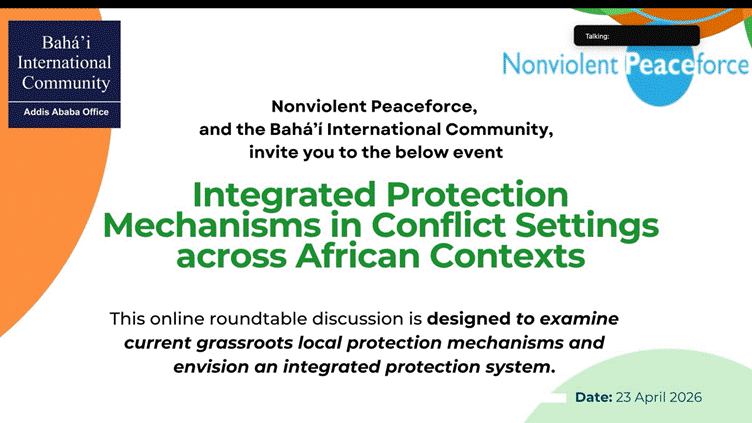
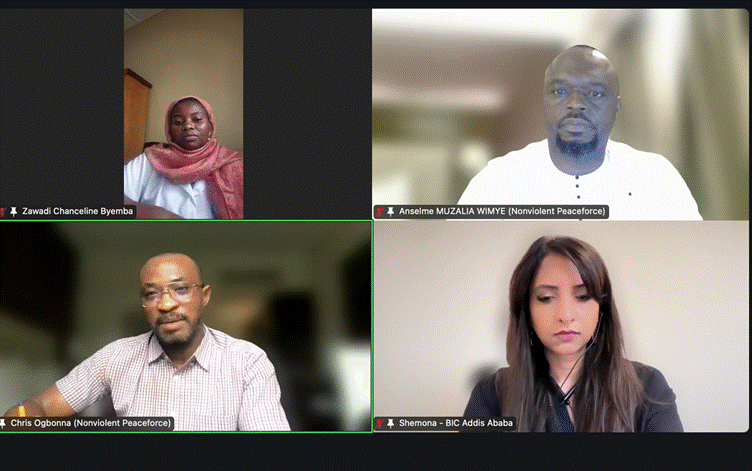
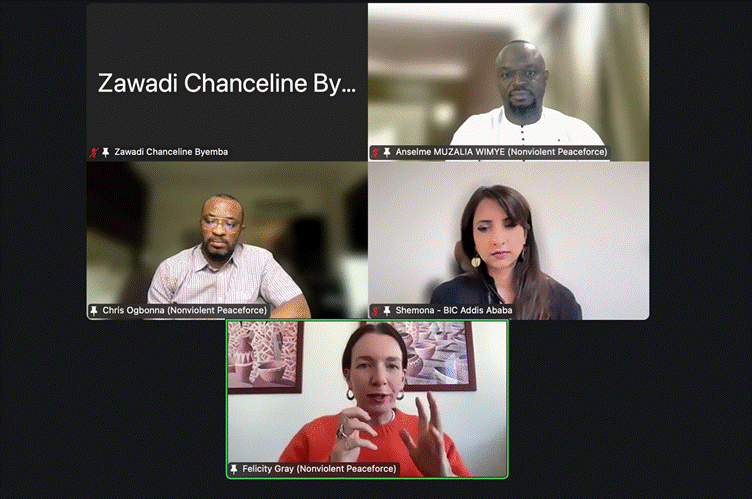
On 23 April 2026, Nonviolent Peaceforce (NP) and the Bahá’í International Community’s (BIC) Addis Ababa Office brought together practitioners, researchers, and advocates to examine the effectiveness of local protection mechanisms and the urgency of integrating them with formal institutions. Drawing on field experience from the DRC and Sudan, participants highlighted how communities already fill critical protection gaps left by the absence of state and international actors through early warning networks, protective presence, local mediation, and community-led responses to sexual violence and displacement.
In the DRC, practitioners described how community health cooperatives and Village Savings and Loan Associations (VSLAs) allow families to withstand looting and forced displacement without systemic collapse. Radio and mobile-based early warning networks enable communities to monitor armed group movements and mount organised responses before violence escalates. In the Kivu regions, women sustain local economies through cross-border trade and agriculture even as traditional roles are disrupted, and civil society-led programmes that engage local men have shifted social norms while addressing sexual violence. All of this illustrates the possibility of responding to an immediate crisis while building longer-term safety. Civil society’s capacity to reintegrate youth exiting armed groups further illustrates the depth of local protective capacity that formal actors rarely reach.
In Sudan, the dialogue heard how community groups in El Fasher identified early warning indicators that the city would fall and responded by establishing mass relocation corridors and providing protective accompaniment to reduce the risk of abduction and extortion. When international actors were unprepared, these same networks absorbed separated children, accompanied survivors of sexual violence to health facilities, and de-escalated ethnic tensions inside IDP camps. Participants noted that women providing care to survivors were frequently survivors themselves. This is a stark reminder that sustaining community protection depends on attending to the needs of those doing the protecting.
Participants called for knowledge-sharing systems that integrate community-led evidence into regional policy platforms; stronger accountability mechanisms for governments to foster local agency; and a reframing of international organisations as support structures for communities rather than primary providers. Above all, the dialogue stressed the need to care for the caregivers - ensuring that psychosocial support and health provision reach frontline actors who assume enormous personal risk to maintain protection structures. Regular cross-sector dialogue, of the kind this event modelled, was seen as essential to sustaining the learning and trust that effective protection requires.
The dialogue closed with a shared conviction: strengthening community-centred protection is not a soft complement to formal institutions: it is a precondition for any protection system that is accountable to the people it claims to serve.