
Gender as Risk, Gender as Protection
This piece responds to and draws on research published by the Humanitarian Policy Group (HPG), in partnership with Nonviolent Peaceforce and Fight for Humanity, on how civilians use gender as a protection strategy in conflict. Read the full report: “Gender norms and protection: navigating agency, risk and backlash”, co-authored by Anki Sjöberg, Ján Michalko and Gemma Davies. Additional stories and details are drawn from NP's own programs.
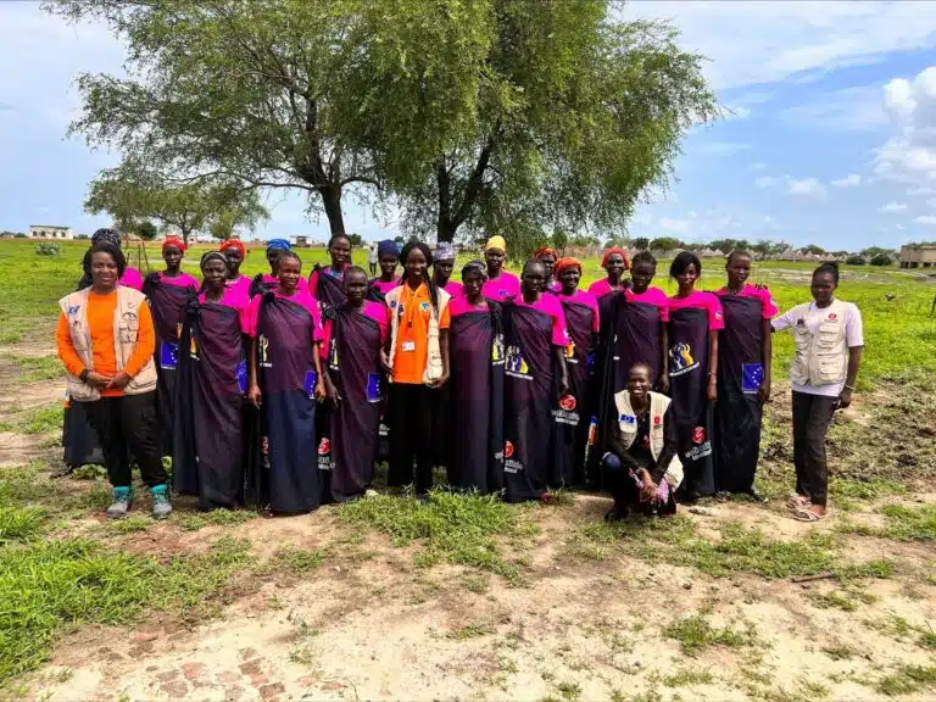
In the village of Pariak, in South Sudan's Upper Nile, a woman named Elizabeth* heard that a man in her community, Levi*, was abusing his wife. Elizabeth was a leader in their local Women's Protection Team (WPT), trained and supported by NP. They decided to put their training to use and knock on Levi’s door.
He was shocked when he opened it and was met by a group of stern-faced women. It never crossed Levi's mind that a group of women would have the audacity or confidence to confront him for his wrongdoings. Elizabeth said, "We are here to promote peace in your home,” and then they got to talking.
⇨ Glimpses of Transformation in Upper Nile, South Sudan
How might we understand Elizabeth and her team’s intervention? It's tempting to reach for one of two easy stories. Women are naturally more peaceful, or women are inherently more at risk, and this is a story about vulnerable people finding courage anyway. HPG’s research paper argues that neither is quite right, and both simplify what's actually going on.
The sharper questions: What relationships did these women already have in the community and with Levi before they knocked? What norm were they leaning on — perhaps the recognized standing of "mothers of the community," which carries different weight than if a stranger, or a man, had shown up? And what did it cost them to be so visible? What did their training from NP, an international organization, actually add?
These are the types of questions that HPG’s recent research seeks to examine. How do gender norms shape risk in conflict, how do gender norms change when people mobilize to protect themselves, how do protection actors understand or misunderstand gender norms — and what all that means now, as funding and political space for this work shrink.
Drawing on, adapting, and challenging gender norms
Elizabeth's group didn't stumble into their standing with Levi. They knew their positionality in their community — in large part, how their gender shapes it — and navigated the situation deliberately. Around the world, civilians do the same, leveraging gender norms as part of their own self-protection. Sometimes that means leaning into norms, sometimes adapting them, and sometimes it means challenging them outright.
In Iraq, a Women's Protection Team did all three at once. Dalia*, a WPT member, and her colleagues were approached by women in a nearby village who were living with restrictions on leaving home, child marriage, and a public health crisis from uncollected garbage, but had no way to be heard. Dalia's team used their own standing to broker something the village had never previously had: a meeting between its women and the head of the local municipality. It worked, in part, because Dalia's group represented something recognized and credible — an established, NP-trained WPT — and therefore received a reception that individual women showing up alone would not have had. One woman admitted she hadn't trusted that any organization would actually help until she saw it happen in front of her. Another said her husband only agreed to let her attend because other women were going too, and even then, she had to bring her son along. The norm bent, just enough, because an existing, trusted group had established its own credibility.
Men have also used their access to male-dominated spaces to address sensitive issues, such as online extortion against women in Iraq. There have been situations in which male community members engage directly with perpetrators in ‘man-to-man conversations’ to stop abuse. Lam Deng, a Gender Champion with NP in South Sudan, has spoken publicly about the expectation that men don't show pain, don't grieve visibly, don't admit when they're struggling. He's pushed back on that directly, encouraging men to speak about hardship rather than carry it alone, because the alternative has cost lives.
Men face gender-based risk too — notably in conscription, which pulls them out of civilian life and into the armed forces on a mass scale specifically because of their gender. Anastasiya Marchuk, from our Ukraine program, has pointed to a less-discussed consequence: conscription doesn't just affect combatants, it hollows out the humanitarian response itself, as conscripted humanitarian workers leave organizations short of the people best placed to reach frontline communities.
Reintegration carries its own gendered weight. The same norms that send men to the frontlines also shape how they process and heal once back in civilian life. NP's work with veterans navigating that return shows how much is left unaddressed when reintegration is treated as a private, individual burden rather than a communal one. One veteran, Yurii, found what helped most wasn't something he found alone. A six-day family retreat gave him and his wife shared space to rebuild connection and psychological safety, free from the noise and triggers of daily life.
Leveraging or challenging gender norms for safety is also risky
When people lean into or push against gender norms to protect themselves and their communities, that agency can come with a cost. Strengthened protection isn't only about reducing exposure to harm — it also means navigating trade-offs between agency and risk in highly gendered conflict settings.
In South Sudan and Iraq, WPT members deliberately move as a group, in matching t-shirts or vests, borrowing the credibility of an organized, recognized team. One WPT leader in South Sudan described the effect: gang members "stop when they see us" (more on page 28 of the report). But HPG’s research shows that the same visibility that deters violence in one moment can invite backlash, stigma, or targeted harassment in another — especially for anyone whose public role already breaks with what's expected of their gender.
Further findings suggest that gendered protection risks affect everyone in distinct, interconnected ways. Therefore, gender must be more inclusive than ‘women and girls’.
In some conflict settings, it’s not uncommon for boys and men to perceived as potential perpetrators, or face suspicion of affiliation with armed groups. Both of which increases their risk of being killed, tortured, arbitrarily detained, and forcibly recruited.
For LGBTQI+ and gender-diverse people, even where their presence is visible, legal and social constraints often keep protection actors from engaging with them at all. In South Sudan and Iraq, restrictions limit not just the visibility of LGBTQI+ individuals and organizations, but protection actors' ability to work with them or research their risks in the first place. Even in Ukraine, where there's comparatively more openness, LGBTQI+ concerns remain marginal in practice.
What this means for how we work
NP echoes the call made by HPG for more systematic but context-sensitive gendered risk analysis in protection work and has found such analysis to be essential in our own work. In addition to providing protective accompaniment or protective presence for those who face elevated risks, NP staff supports partners to perform safety assessments, and coach communities on inclusive gender analysis and practical mitigation strategies. Although these measures do not eliminate risk completely, they help to identify it, redistribute it, and make it more manageable.
NP also notes the shrinking civic space and lack of global attention on inclusive gendered risk analysis. Despite the current politicization of gender and restrictions on gender-focused work through efforts like the expanded “Global Gag Rules”, research continues to show that recognizing gendered and intersectional protection risks is essential to effective humanitarian, protection and development work. Context-specific gender risk analysis must be integrated across humanitarian contexts, and the results of such analysis used to inform programming and mitigate risk.
⇨ Related: Gender Peace Champions Creating a Safe Space in Conflict Zones of Basilan
*names changed
* * *
This paper is part of NP’s ‘Contributing to Peaceful and Safe Societies’ project, which focuses on generating evidence and learnings to enhance the safety and security of civilians through locally led, nonviolent and relational approaches to prevent and respond to risks of violence.