
Joachim Kleinmann: Protect the Protectors
The following remarks were delivered by Joachim Kleinmann, Head of Ukraine Programming at Nonviolent Peaceforce, during a side event at Protection of Civilians Week 2026 at the United Nations in New York. See the full event recording here. The remarks have been lightly edited for readability.
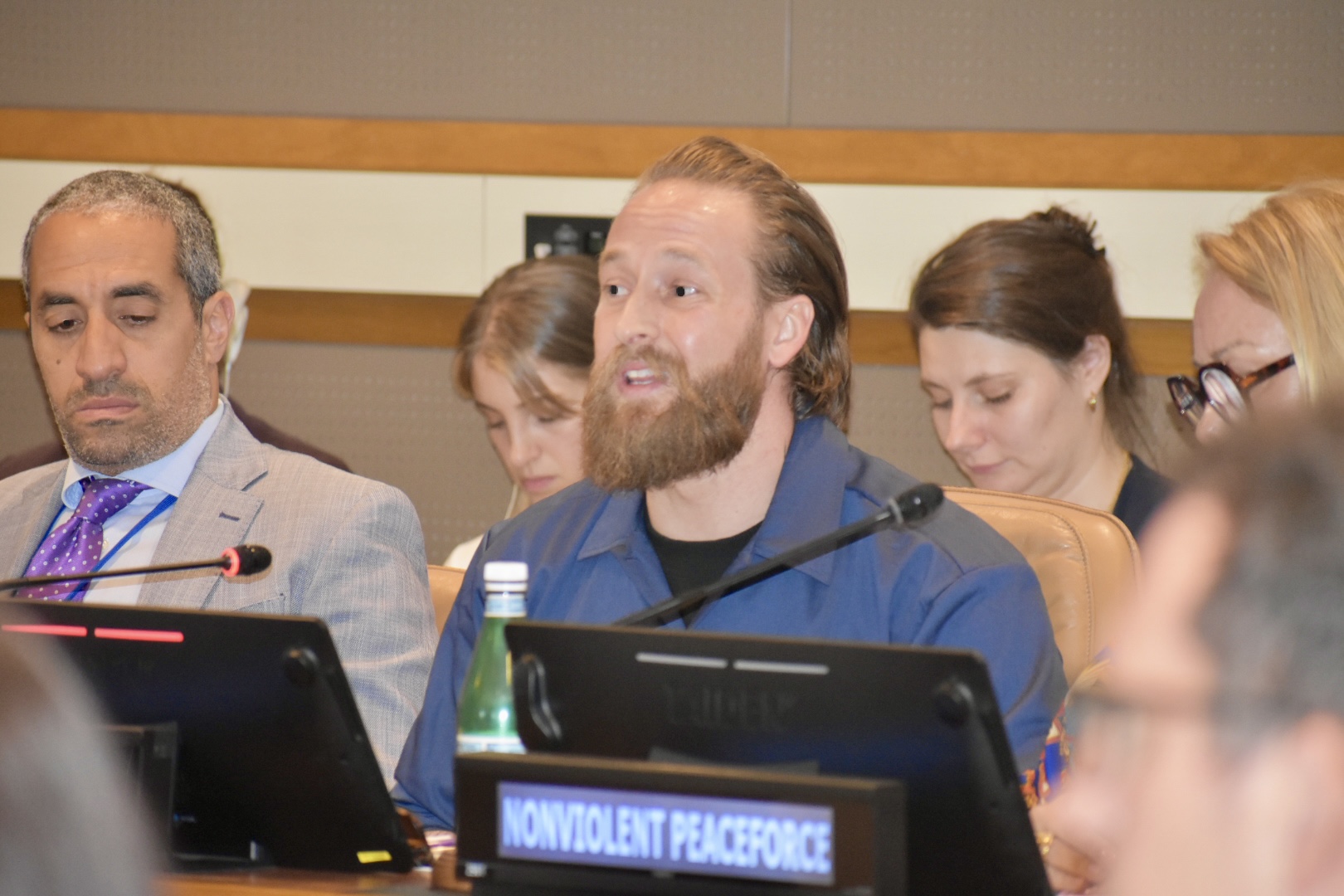
Thank you. And thank you for holding the space for frontline volunteers and communities who have stepped up in the face of extreme aggression.
I think it's really important to note that when we say local humanitarians were volunteers, we are talking about civilians by and large. I mean, what happened in early 2022 when Russia invaded Ukraine and escalated the conflict that had been ongoing, what we saw was communities and civilians themselves step up and support their neighbors and do the thing that the international community was not doing in its initiation.
So, through this very autonomous and organic community-led response, which has matured and organized into volunteer networks and NGOs, we began to see an extremely large gap. What we saw was an outsourcing of risk from the international community, who is hesitant to step into high-risk areas, and offloading that onto local humanitarians and, again, to civilians who are taking the space. So what we found was the best way to protect civilians is to protect the people who are protecting them.
🗎 Responsible Partnerships? Risk, protection & local actors in the Ukraine humanitarian response
View publication →
This is literally what this conversation is about: how do we operationalize that, push that forward, and maintain that important space? Because I think we need to look at it in two distinct but equally important directions. The first one is we need to maintain the space that this is very human-centered and ask: how do we keep people safe today? How do we ensure that the people who are showing up for the community, stepping into the threat in the name of civilian protection, come home and are able to do this again?
The other piece of this, which the gentleman from Australia mentioned, is—I think there's a shift—this week I've heard a lot of discussion around political will and it feels ambiguous. And I think what you mentioned about moving into political accountability is a really important acknowledgement and the beginning of stepping into what this looks like on a structural system level.
So the first part is on-the-ground realities: how do we keep people safe? The second one is how do we put pressure on systems that are meant to keep people safe that currently are not rising to the occasion for which they were developed?
Changing Nature of Humanitarian Risk
To ground this in the Ukrainian context, and this is certainly true in what's happening in Palestine, in Gaza, the frameworks that we've designed, our traditional assumptions about what humanitarian systems and humanitarian protection look like, are being challenged. To name the elephant in the room, a big piece of this has to do with the advent and increase of drone warfare.
To ground our conversation in this, an INSO report that was put out a few months ago mentioned that 68% of humanitarian casualties and deaths were directly attributed to short range drones. A lot of us know them as “first person drones.” This is completely and fundamentally changing the landscape of humanitarian work and what it means to stay safe.
🗎 Expanding Duty of Care: Provision of Frequency Analysers for Frontline Humanitarian Networks in Ukraine
View publication →
One of the first questions is: does this system that we're participating and working in, is it contemporary and able to adapt to the challenges that we're facing fast enough? The first thing we need to do is listen to frontline volunteers. They know exactly what they need to stay safe. We don't need to invent new strategies. They're on the line. They're feeling and hearing the drones above them and they know what they need to stay safe.
It's our job to ensure that those mitigations and those new practices for safety are compliant with IHL, are in-line with humanitarian principles, and have considerations of do no harm within a wider principled response, not just one that is strictly restricted by legal frameworks. And then the question is, how do we act on those quickly? Because the information is there. We don't need to invent new solutions. A lot of these solutions are based in the community and are growing and adapting as the context shifts.
Even when they're uncomfortable for us from an IHL perspective or an international humanitarian perspective, I think it's really important that we host those conversations, that we get together to build consensus on what these local strategies look like in practice and how we can interact with them as best as possible. And, understanding that these people are risking their lives every day, if we do come to a place of acknowledging that their strategies are non-compliant, how do we continue to interact with these frontline responders, who are the frontline and most important protections of civilians, in a way that reduces harm and reduces the collateral damages? And how do we act on that quickly so there's not a long delay?
Duty of Care
In short, what we're talking about is duty of care. And this is something that NP is really championing with Civic and with SDC and several of their partners, local partners, CSO Alliance, RCC in Ukraine, as we're living this situation. Duty of care is how do we keep people safe. This is what this is about.
🗎 Protecting Those Who Stay: Rethinking Duty of Care
View publication →
We need to maintain is our funding to ensure that we prioritize the safety of civilians and humanitarians and not think of duty of care or humanitarian safety as an asterisk or something to be proud of, but as a fundamental aspect of humanitarian work. This comes with minimum standards to not have different elements of protection siloed at individual organizations who are willing to take risks or step outside the box, but collectively do this so that all humanitarians interacting with international systems have the same types of protections; that they can take them for granted the same way that I do as an international worker.
And I'd like to note that this plays in equally with physical protections as it does with mental protections. And I think looking through frontline responders in Ukraine and globally, local responders, I think the interaction with burnout and what that looks like, to live in your community and work every single day for a lifetime, what that does. So those considerations are really important.
🗎 Psychosocial Protection in Humanitarian Crises
View publication →
I think the other aspect of it is we need to, especially in these spaces, acknowledge system breakdown, that we have really good intentions in these rooms and we speak about political wills. And now the real question is: how do we action that political will into substantive reality for the frontline responders? Because as we're moving towards realization of the Grand Bargain and localization, that can't come with a continuation of outsourcing risk.
We just need to put our money where our mouths are, because what happens is when IHL, the realities of IHL, are not realized on the front line or with local communities, then local actors take it on themselves to stay safe. Duty of care is our best option to keep people safe and an acknowledgement that something is not working.
As a last point, I think we need to talk about risk sharing a little bit, especially in spaces like this. At first, when we talked about risk sharing, we were talking about “how do we share the risk space, the physical space in frontline communities?” For people in this room and the cabinets in these buildings, taking the political risk and the reputational risk is how we can actually show up for frontline responders: by having difficult conversations.
A big piece of that is human-centered, because yes, we represent countries and institutions—at the same time, we are people sitting in chairs with microphones hosting conversations to push this further. As a last piece, aside from the larger structure, I would say aspects of solidarity and courage to name these realities and to step into uncomfortable space so that those realities are consistently brought to the table.
As a last piece, and I'll come back to how you opened this meeting, for me a sense of urgency to act, which I spoke about at the beginning, because our delays and over caution can lead directly to harm, is keeping people centered in this. Because once you feel it somewhere in your chest—and this isn't hypothetical or something that's only in a speech, it's there. It's that sense of urgency where action comes from.
Lessons from Ukraine
I'm trying to speak from my lived experience in Ukraine, from what I see every single day, but I think this applies to contexts globally, especially when you're talking about the types of threats we are seeing—and again, to specifically name the short range attack drones, this is the biggest threat. A lot of this needs to be founded in that, but not limited to it.
I think one of the most important aspects of the Ukraine response that should be echoed and mirrored in other places is that we have the attention from the globe. There's a very different type of proximity to Ukraine than many other conflicts around the world, and that comes with resources and attention. What we need to do is leverage the resources and attention we have in Ukraine to identify and solve solutions for this problem, and then not silo them just to Ukraine, a European nation, but set those minimum standards globally to other contexts that don't have the same resources and attention.
That also comes with trust of local partners, something that Ukraine has done very well, again because of the autonomous and very proactive, robust response by civil society. The international community has worked closer with civil society actors and NGOs and local organizations than anywhere I've seen. That realization of the Grand Bargain—again, needs to come with resources and systemic and infrastructural supports—needs to be echoed.
Thank you.